
Introduction
Psoriasis is a common chronic inflammatory skin disorder affecting approximately 3% of the global population. It is characterized by a complex interplay between genetic susceptibility, immune dysregulation, and aberrant keratinocyte biology, leading to epidermal hyperproliferation, parakeratosis, and hyperkeratosis with inflammatory leukocyte infiltration into both the dermis and epidermis. These pathological changes collectively result in thickened, scaly psoriatic plaques.
Although the precise etiopathogenesis of psoriasis remains incompletely elucidated, sustained immune activation and excessive keratinocyte proliferation are recognized as central events in disease development. Systemic low-grade inflammation is a consistent hallmark of psoriasis, contributing not only to cutaneous manifestations but also to associated comorbidities. The persistent hyperproliferative state of keratinocytes in lesional skin further exacerbates epidermal thickening and impaired barrier function.
Given the incomplete understanding of its molecular mechanisms, there is an urgent need to explore novel therapeutic targets and develop effective treatment strategies for psoriasis. In this context, natural products with multi-target pharmacological actions have gained increasing scientific attention.
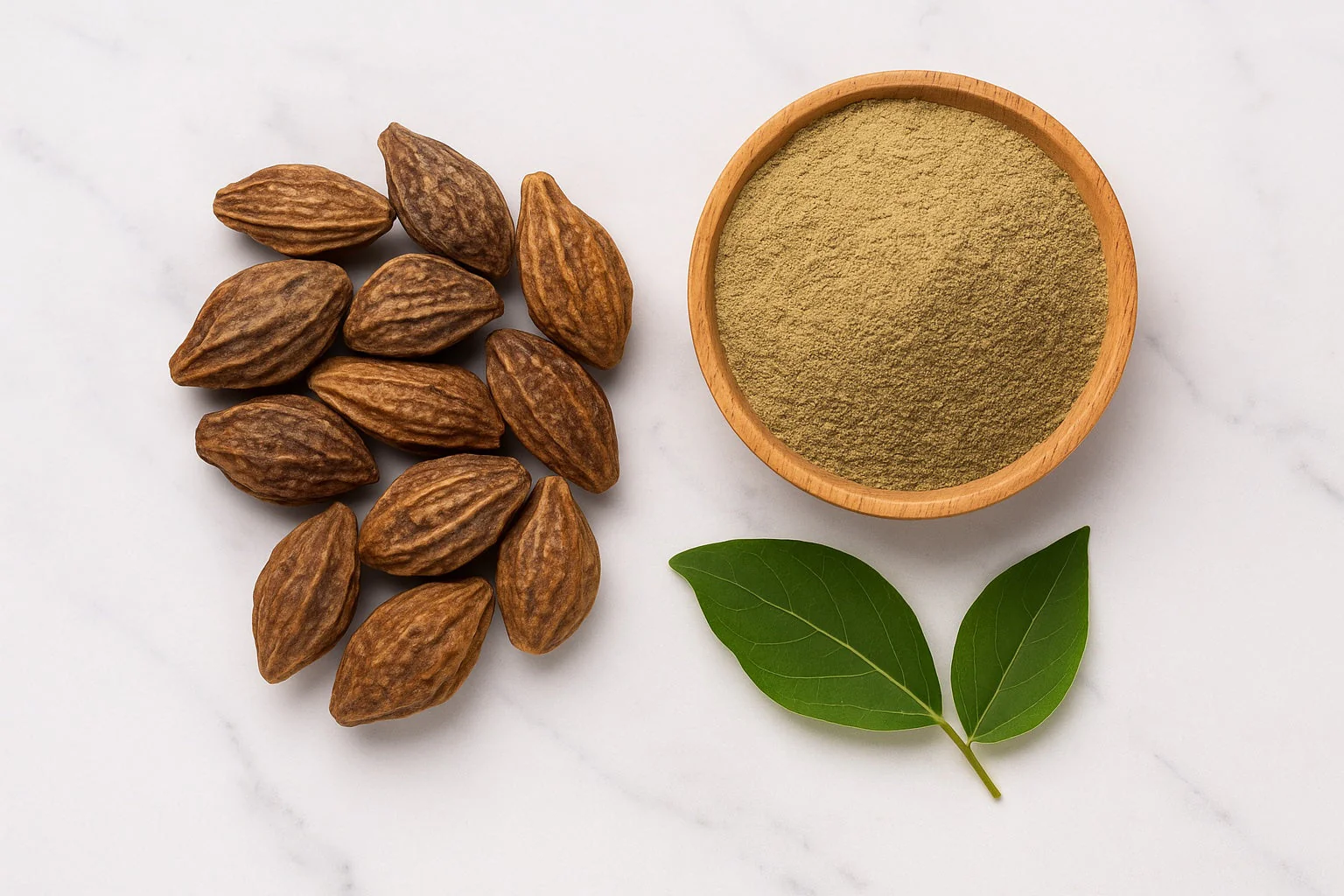
Terminalia chebula Retz., a well-established traditional medicinal plant widely used in Asian systems of medicine, has been reported to possess significant antioxidant, anti-inflammatory, and antimicrobial properties. Phytochemical investigations of its fruits have identified several bioactive polyphenolic constituents, including chebulagic acid, chebulanin, and chebulinic acid, which contribute to its therapeutic potential.
Experimental studies have demonstrated that chebulanin exerts anti-inflammatory effects in lipopolysaccharide-stimulated RAW 264.7 macrophage cells as well as in collagen-induced arthritis models in mice. Furthermore, Terminalia chebula has been reported to modulate metabolic and inflammatory pathways, suggesting its potential role in inflammatory and immune-mediated disorders. These findings collectively indicate that Terminalia chebula may represent a promising natural therapeutic agent for conditions such as psoriasis, where inflammation and keratinocyte hyperproliferation are central pathological features.1
Therapeutic role of Haritaki in psoriasis
Anti-inflammatory activity:
Haritaki exhibits potent anti-inflammatory effects by downregulating key mediators such as TNF-α, IL-1β, and IL-6, thereby reducing erythema, scaling, and inflammatory plaque formation in psoriatic lesions.2
Immunomodulatory effects:
Bioactive polyphenols including chebulagic acid, chebulinic acid, and chebulanin modulate immune responses by regulating T-cell activation and Th1/Th17 cytokine balance, restoring immune homeostasis in psoriatic pathology.
Antioxidant and cytoprotective properties:
Haritaki demonstrates strong free radical scavenging activity, reducing oxidative stress–induced keratinocyte damage and preventing lipid peroxidation, thereby supporting epidermal integrity.
Antimicrobial protection:
Its broad-spectrum antimicrobial activity helps prevent secondary bacterial and fungal infections in psoriatic plaques, promoting improved lesion healing.
Wound healing and tissue regeneration:
Haritaki enhances fibroblast proliferation, collagen synthesis, and epithelial regeneration, contributing to faster healing of chronic psoriatic lesions and restoration of skin barrier function.
Mechanism of action in psoriasis
Inhibition of inflammatory signaling pathways:
Haritaki suppresses activation of NF-κB and MAPK signaling pathways, leading to reduced transcription of pro-inflammatory cytokines involved in psoriatic inflammation.
Modulation of cytokine network:
It downregulates TNF-α, IL-17, and IL-23 expression, thereby attenuating Th17-driven immune responses central to psoriasis progression.
Regulation of keratinocyte proliferation and differentiation:
Active phytoconstituents regulate epidermal cell signaling, resulting in normalized keratinocyte proliferation and improved differentiation, reducing plaque thickness.
Antioxidant enzyme activation:
Haritaki enhances endogenous antioxidant defense systems such as superoxide dismutase (SOD), catalase, and glutathione peroxidase, thereby reducing oxidative tissue injury.
Gut–skin axis modulation:
Recent research suggests that Haritaki may influence the gut microbiome and systemic immune regulation, indirectly contributing to reduced skin inflammation via the gut–skin axis.
Therapeutic advantages of Haritaki in psoriasis
Multi-target pharmacological profile:
Haritaki acts on multiple pathological pathways including inflammation, oxidative stress, immune dysregulation, and microbial imbalance, making it a comprehensive phytotherapeutic agent.
Safe long-term herbal intervention:
Compared to conventional immunosuppressants, it offers a favorable safety profile and potential suitability for long-term supportive therapy.
Effective in chronic plaque psoriasis:
Its anti-inflammatory and anti-proliferative actions are particularly beneficial in chronic plaque-type psoriasis, reducing scaling and lesion severity.
Compatibility with integrative medicine:
Haritaki can be used as an adjunct to topical or systemic therapies, potentially enhancing therapeutic outcomes and reducing relapse frequency.
Traditional and evidence-based validation:
Extensively described in Ayurveda as a Rasayana drug, Haritaki is supported by emerging experimental studies validating its anti-psoriatic potential.
Conclusion
Haritaki (Terminalia chebula) demonstrates significant therapeutic potential in psoriasis3 through its anti-inflammatory, immunomodulatory, antioxidant, antimicrobial, and tissue-regenerative properties. By targeting key molecular pathways such as NF-κB and Th17-mediated cytokine signaling, it helps restore immune balance and regulate keratinocyte hyperproliferation. Its multitargeted mechanism, combined with a favorable safety profile and traditional Rasayana status, supports its role as a promising phytotherapeutic agent in integrative psoriasis care, although further clinical trials are required to establish standardized dosing and long-term efficacy.
References:
- An J, Li T, Dong Y, Li Z, Huo J. Terminalia Chebulanin Attenuates Psoriatic Skin Lesion via Regulation of Heme Oxygenase-1. Cell Physiol Biochem. 2016;39(2):531-543. doi:10.1159/000445645. https://pubmed.ncbi.nlm.nih.gov/27383847/
- Kim HJ, Song HK, Park SH, et al. Terminalia chebula Retz. extract ameliorates the symptoms of atopic dermatitis by regulating anti-inflammatory factors in vivo and suppressing STAT1/3 and NF-ĸB signaling in vitro. Phytomedicine. 2022;104:154318. doi:10.1016/j.phymed.2022.154318. https://pubmed.ncbi.nlm.nih.gov/35830757/
- Kumar Bhatted S, Arun Shende H, Kumar Singh H, Kumar A. "Ayurveda management of Palmoplantar Psoriasis (Vipadika) -a case report". J Ayurveda Integr Med. 2023;14(2):100704. doi:10.1016/j.jaim.2023.100704. https://pmc.ncbi.nlm.nih.gov/articles/PMC10307819/