
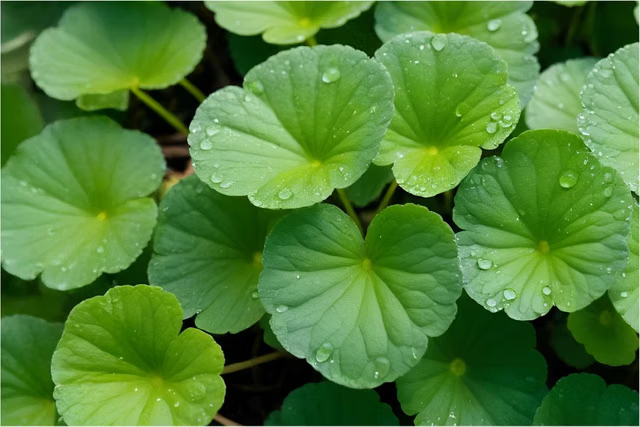
Introduction
Wound healing is a coordinated biological process involving inflammation, proliferation, angiogenesis, and tissue remodeling. Disruption of these phases may result in chronic wounds or excessive scar formation. Scar remodeling is particularly important as abnormal collagen deposition can impair both function and cosmetic appearance. Ayurveda recognizes Mandukaparni as a potent Rasayana and Vrana Ropana herb, widely used for promoting tissue repair and restoring skin integrity. Contemporary studies have demonstrated that its phytoconstituents influence multiple cellular pathways involved in wound healing and regeneration.1
Bioactive constituents and mechanisms of action
The regenerative effects of Centella asiatica are primarily attributed to triterpenoid saponins, including asiaticoside, madecassoside, asiatic acid, and madecassic acid.2 These compounds stimulate fibroblast proliferation and migration, leading to enhanced granulation tissue formation and accelerated wound closure. Asiaticoside has been shown to increase collagen synthesis and hydroxyproline content, thereby improving the tensile strength of healing tissues and supporting organized scar formation.
A significant mechanism involves modulation of transforming growth factor-beta (TGF-β), a key regulator of tissue repair and fibrosis. By regulating TGF-β signaling, Centella asiatica promotes balanced collagen deposition and prevents excessive fibrosis, which is crucial for optimal scar remodeling. Additionally, the herb enhances angiogenesis through increased expression of vascular endothelial growth factor (VEGF), ensuring adequate oxygen and nutrient supply to regenerating tissues.
Anti-inflammatory and antioxidant effects
Persistent inflammation and oxidative stress are major contributors to delayed wound healing and pathological scar formation. Madecassoside and related triterpenes suppress pro-inflammatory mediators such as TNF-α, IL-1β, and IL-6, facilitating progression from the inflammatory phase to the proliferative phase of healing. Simultaneously, the antioxidant constituents of Centella asiatica neutralize reactive oxygen species, protecting fibroblasts and keratinocytes from oxidative damage and supporting tissue regeneration.
Role in scar remodeling
Scar remodeling represents the final stage of wound healing and determines long-term tissue quality. Clinical and experimental studies have demonstrated that Centella asiatica improves scar texture, elasticity, pigmentation, and overall appearance. The herb also influences matrix metalloproteinases (MMPs), promoting appropriate extracellular matrix turnover and preventing excessive collagen accumulation. These actions contribute to reduced hypertrophic scar formation and enhanced restoration of normal tissue architecture.3
Future perspectives
Clinical investigations involving topical creams, gels, and oral formulations of Centella asiatica have reported beneficial effects on postoperative wounds, burns, traumatic injuries, and chronic ulcers. Systematic reviews indicate improved wound healing and scar maturation, although larger randomized controlled trials are needed to establish standardized treatment protocols. Recent advances in regenerative medicine have incorporated Centella asiatica extracts into hydrogels, nanofibers, and bioengineered wound dressings, enhancing bioavailability and sustained delivery of active compounds.
Conclusion
Centella asiatica (Mandukaparni) represents a valuable bridge between traditional Ayurvedic medicine and modern regenerative therapeutics. Its ability to stimulate fibroblast proliferation, enhance collagen synthesis, promote angiogenesis, regulate inflammation, and modulate extracellular matrix remodeling makes it an effective natural agent for tissue regeneration and scar management. Continued research and clinical validation may further establish its role in evidence-based wound care and regenerative medicine.
Reference:
- Arribas-López E, Zand N, Ojo O, Snowden MJ, Kochhar T. A Systematic Review of the Effect of Centella asiatica on Wound Healing. Int J Environ Res Public Health. 2022;19(6):3266. Published 2022 Mar 10. doi:10.3390/ijerph19063266 https://pmc.ncbi.nlm.nih.gov/articles/PMC8956065/
- Diniz LRL, Calado LL, Duarte ABS, de Sousa DP. Centella asiatica and Its Metabolite Asiatic Acid: Wound Healing Effects and Therapeutic Potential. Metabolites. 2023;13(2):276. Published 2023 Feb 14. doi:10.3390/metabo13020276 https://pmc.ncbi.nlm.nih.gov/articles/PMC9966672/
- Bylka W, Znajdek-Awiżeń P, Studzińska-Sroka E, Dańczak-Pazdrowska A, Brzezińska M. Centella asiatica in dermatology: an overview. Phytother Res. 2014 Aug;28(8):1117-24. doi: 10.1002/ptr.5110. Epub 2014 Jan 7. PMID: 24399761. https://pubmed.ncbi.nlm.nih.gov/24399761/