
Introduction
Psoriasis is a chronic immune-mediated inflammatory skin disorder characterized by aberrant keratinocyte hyperproliferation, resulting in well-demarcated erythematous plaques covered with thick silvery scales. The disease is now recognized as a systemic condition involving complex interactions among genetic susceptibility, immune dysregulation, epidermal barrier dysfunction, inflammation, altered apoptosis, and dysregulated cell proliferation. Evidence suggests that impairment of skin barrier integrity contributes to sustained inflammatory signaling and epidermal hyperplasia, thereby perpetuating disease progression.
The global prevalence of psoriasis is estimated to be approximately 2–3% of the population, with notable variability across different geographic regions and ethnic groups. This heterogeneity reflects the multifactorial nature of the disease, including genetic, environmental, and immunological determinants.
Accurate diagnosis and appropriate disease stratification are critical in guiding therapeutic decision-making and improving patient outcomes. Treatment strategies are generally determined based on disease severity. Mild to moderate psoriasis is primarily managed with topical therapies, whereas moderate to severe forms often require systemic interventions such as phototherapy, acitretin, methotrexate, cyclosporine, or biologic agents targeting specific immune pathways. Notably, a significant proportion of patients (approximately 80%) present with mild disease and are managed with topical treatment modalities.
Herbal medicine represents one of the oldest therapeutic systems and continues to be widely utilized globally. The World Health Organization estimates that nearly 80% of the global population relies on traditional plant-based medicinal systems for primary healthcare. In this context, medicinal plants have gained renewed scientific interest due to their multi-target pharmacological properties and favorable safety profiles.
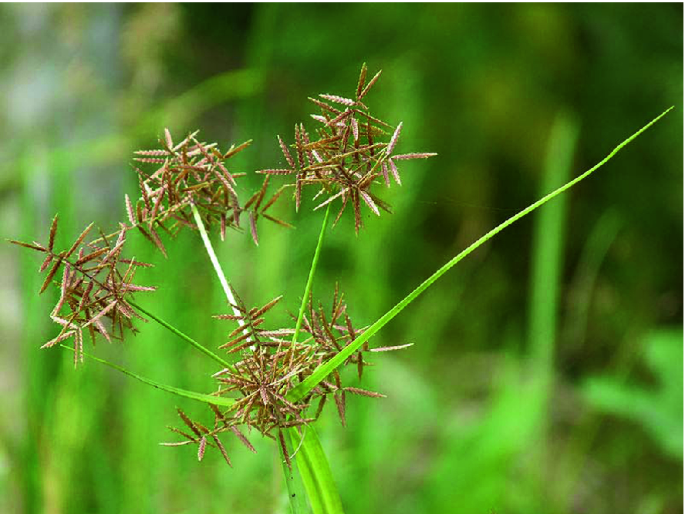
Cyperus rotundus (commonly known as nut grass) is a medicinal plant reported to exhibit anti-psoriatic, anti-inflammatory, antioxidant, and anticancer properties. Phytochemical investigations have identified flavonoid constituents within C. rotundus that demonstrate potential antipsoriatic activity by modulating inflammatory pathways and keratinocyte proliferation. Recent studies have suggested that these bioactive compounds may contribute to disease attenuation in psoriasis through multi-mechanistic actions.
In this context, the present study aims to computationally evaluate the active phytoconstituents of Cyperus rotundus and assess their potential biological activity relevant to psoriasis management, with a focus on identifying molecular interactions involved in disease modulation.1
Phytochemical profile of Musta relevant to psoriasis
Bioactive constituents:
Cyperus rotundus contains a variety of pharmacologically active compounds including flavonoids, sesquiterpenes, alkaloids, and phenolic acids. Key constituents such as cyperene, cyperotundone, and flavonoid derivatives are associated with anti-inflammatory and antioxidant activities.
Pharmacological relevance:
These phytoconstituents exhibit multi-target biological actions, making Musta a potential candidate for modulating immune and inflammatory pathways involved in psoriasis pathogenesis.
Therapeutic role of Musta in psoriasis
Anti-inflammatory activity:
Musta exhibits significant anti-inflammatory effects by suppressing pro-inflammatory mediators such as TNF-α, IL-1β, and IL-6, thereby reducing erythema, edema, and plaque formation in psoriatic lesions.
Immunomodulatory effects:
Bioactive compounds in Musta regulate immune responses by modulating Th1/Th17 cytokine balance, thereby restoring immune homeostasis and reducing autoimmune-driven keratinocyte proliferation.
Antioxidant protection:
Musta demonstrates strong free radical scavenging activity, reducing oxidative stress–induced damage in epidermal cells and preventing lipid peroxidation, which contributes to chronic inflammation in psoriasis.
Antimicrobial activity:
It exhibits antibacterial and antifungal properties, which help prevent secondary infections in psoriatic plaques, thereby supporting skin healing and reducing disease exacerbation.
Wound healing and skin repair:
Musta enhances fibroblast activity, collagen synthesis, and epithelial regeneration, contributing to accelerated healing of psoriatic lesions and restoration of skin barrier integrity.
Mechanism of action in psoriasis
Inhibition of inflammatory signaling pathways:
Musta suppresses activation of NF-κB and MAPK signaling pathways, leading to reduced transcription of pro-inflammatory cytokines involved in psoriatic inflammation.
Modulation of cytokine network:
It downregulates key cytokines such as TNF-α, IL-17, and IL-23, thereby attenuating Th17-mediated immune responses central to psoriasis progression.
Regulation of keratinocyte proliferation:
Phytoconstituents of Musta inhibit abnormal keratinocyte proliferation and promote normal differentiation of epidermal cells, thereby reducing plaque thickness and scaling.
Oxidative stress modulation:
Musta enhances endogenous antioxidant defense systems such as superoxide dismutase (SOD), catalase, and glutathione peroxidase, thereby minimizing oxidative tissue injury.
Neuro-immuno-cutaneous interaction:
Recent studies suggest that Musta may modulate stress-related inflammatory pathways, indirectly influencing the neuro-immuno-cutaneous axis, which plays a role in psoriasis exacerbation.
Therapeutic advantages of Musta in psoriasis management
Multi-target pharmacological profile:
Musta acts on multiple pathogenic mechanisms including inflammation, oxidative stress, immune dysregulation, and microbial imbalance, making it a comprehensive phytotherapeutic agent.
Safer long-term therapeutic option:
Compared to conventional systemic therapies, Musta offers a favorable safety profile, making it suitable for long-term supportive use.
Effective in chronic plaque psoriasis:
Its anti-proliferative and anti-inflammatory effects are particularly beneficial in chronic plaque-type psoriasis, reducing scaling and lesion severity.
Compatibility with integrative medicine:
Musta can be used as an adjunct to conventional or Ayurvedic therapies, potentially enhancing clinical outcomes and reducing recurrence rates.
Traditional validation:
Extensively described in Ayurvedic literature as a drug for Kustha (skin disorders), supporting its ethnopharmacological relevance in psoriasis management.
Conclusion
Musta (Cyperus rotundus) demonstrates significant therapeutic potential in psoriasis2 through its anti-inflammatory, immunomodulatory, antioxidant, antimicrobial, and wound-healing properties. By targeting key molecular pathways such as NF-κB and Th17-mediated cytokine signaling, it helps restore immune balance and regulate keratinocyte hyperproliferation. Its multitarget pharmacological profile and favorable safety potential support its role as a promising phytotherapeutic agent in integrative psoriasis management, although further clinical and mechanistic studies are required to validate standardized therapeutic applications.
References:
- Margiana R. Cyperous Rotundus Active Compounds for Psoriasis Therapy with in Silico Analysis. European Journal of Molecular & Clinical Medicine.;7(06):2020. https://d1wqtxts1xzle7.cloudfront.net/98822331/article_3667_7e224d9a642c4549b9e6791ee3ab7f91-libre.pdf?1676728698=&response-content-disposition=inline%3B+filename%3DCyperous_Rotundus_Active_Compounds_for_P.pdf&Expires=1781868370&Signature=TJlbou1QI6gNuHqGmzAuybDVEy2Yl1EABENUzIVsEPBQ8T~y2h~xrhbyzscduTjle11-MWvVmDR~jXDNzJzLLUMNlrEVh9-q6blUT5u-z74qysK-UpZCEhP0zyJ9iL0etlxesBu7g~fNhDBVT6EJ6I063xNHa-EdrBvAmNSlP93VfstCPIQVoUlnFawZwFhuoPRnux1859gAsUMcJLRx3mrGxYDl95C1Rf5Q7GsmmbjQNTF4nEAo6E0~rPGU90gh57SUuZZApyvhqqiCV7E~oX6UJBeH7WqIDD2WrIkQvRWYaPWu3GP9FPrYBCafrmZ~ME4CFTQLN6b8TfcuTgo4fA__&Key-Pair-Id=APKAJLOHF5GGSLRBV4ZA
- Pillai M, Vitekari H, Mane R. Evaluation of anti-psoriatic activity of Cyperus rotundus and Phyllanthus emblica. International Journal of Biotechnology. 2012 Feb;5(2):028-34. https://www.researchgate.net/profile/Ravindra-Mane/publication/281338175_Screening_of_non-Ionic_Surfactant_for_Enhancing_Biobutanol_Production/links/5783c21708aeca7daac3d55b/Screening-of-non-Ionic-Surfactant-for-Enhancing-Biobutanol-Production.pdf