
Introduction
Psoriasis is a chronic, immune-mediated inflammatory dermatological disorder characterized by relapsing and persistent skin lesions. It is widely regarded as a multifactorial disease in which genetic predisposition, immunological dysregulation, environmental triggers, dietary factors, and behavioral influences collectively contribute to its pathogenesis. Due to its chronicity and recurrent nature, psoriasis is often difficult to manage and significantly impacts quality of life.
In Ayurveda, skin disorders are broadly classified under Kustha Roga, a group of chronic and complex dermatological conditions described extensively in classical texts. Kustha is considered one of the most challenging disease entities due to its persistent course and systemic involvement. Charaka has classified Kustha among the Ashta Mahagada, indicating its severity and therapeutic difficulty.
Ayurvedic literature further categorizes Kustha into Maha Kustha and Kshudra Kustha, encompassing a wide spectrum of skin disorders. Among Kshudra Kustha, Kitibha Kustha is a clinically significant subtype, characterized by symptoms such as roughness of skin (Kharasparsha), blackish discoloration (Shyava), dry and elevated papular lesions (Ruksha Pidika), itching (Kandu), and indurated plaques (Kina). These clinical features closely resemble the morphological presentation of psoriasis.
The pathogenesis of Kitibha Kustha is described as involving vitiation of all three doshas along with involvement of multiple tissues, including Rakta, Mamsa, Lasika, and Twaka Dhatus, reflecting a multi-layered pathological process. This complex interaction of doshic imbalance and tissue dysfunction contributes to the chronic and recurrent nature of the disease, paralleling the immunopathological mechanisms observed in modern psoriasis.1
Relevance of Triphala in Ayurveda
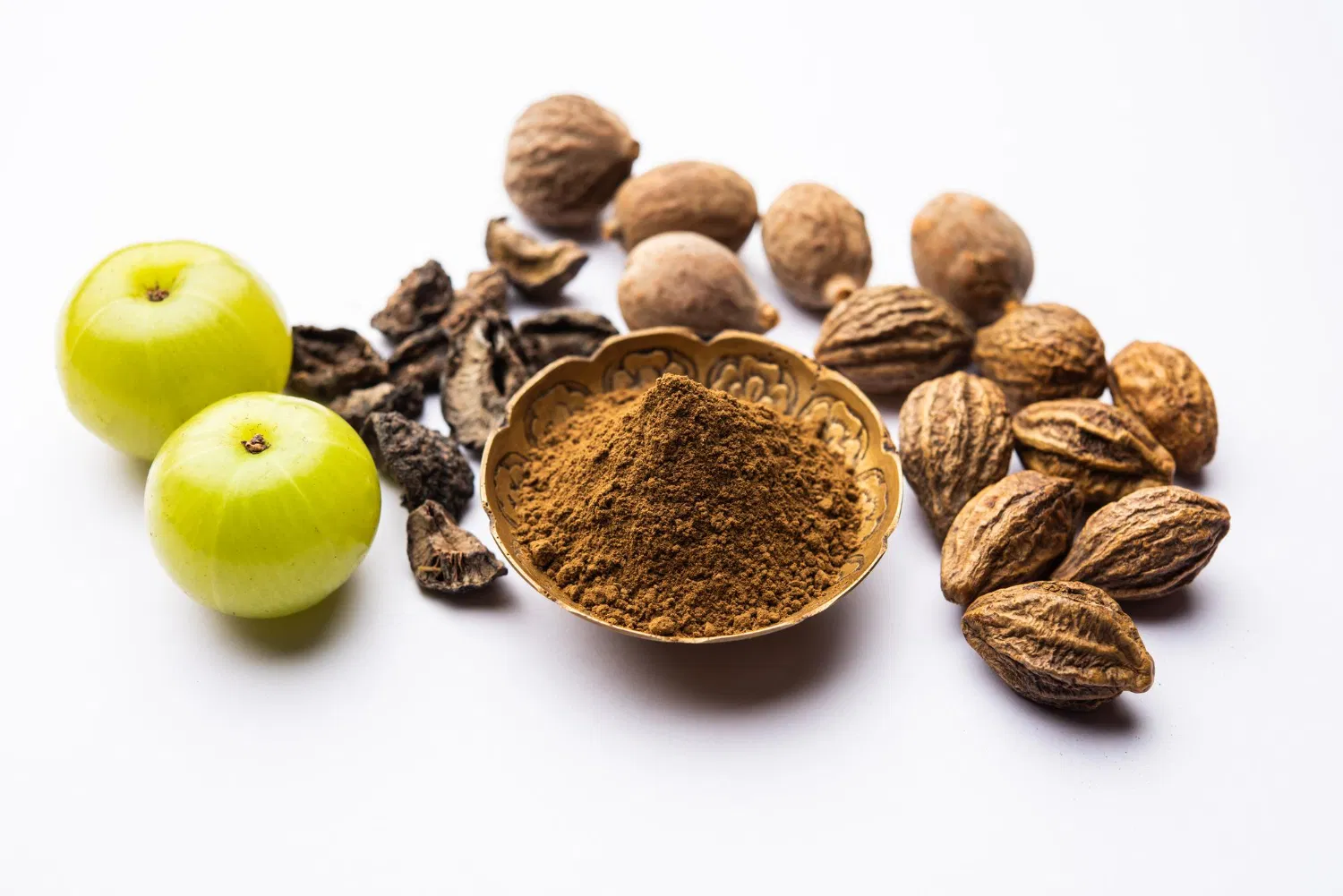
The classical Triphala formulation, composed of Emblica officinalis (Amla), Terminalia chebula (Haritaki), and Terminalia bellirica (Baheda), is a widely recognized polyherbal preparation in Ayurveda. It is traditionally valued for its detoxifying, antioxidant, and rejuvenating (Rasayana) properties, and is reported to support gastrointestinal function, enhance immune modulation, and regulate metabolic homeostasis.
Withania somnifera (Ashwagandha) is an important adaptogenic herb extensively used in Ayurvedic therapeutics. It has demonstrated potential in stress modulation, neuroendocrine regulation, cognitive enhancement, and improvement of physical performance, primarily through its anti-stress and immunomodulatory effects.
Bacopa monnieri (Brahmi) is traditionally employed for its nootropic and neuroprotective activities, contributing to improved memory retention, enhanced learning capacity, and anxiolytic effects. Its pharmacological profile is associated with modulation of cholinergic function and reduction of oxidative stress in neural tissues.
Convolvulus pluricaulis (Shankhapushpi) is another important Ayurvedic medicinal herb known for its central nervous system–protective, anxiolytic, and cognition-enhancing properties. It is commonly used in formulations aimed at alleviating mental fatigue, improving intellectual function, and supporting overall neurological health.2
Collectively, these Ayurvedic formulations and herbs demonstrate significant therapeutic potential in maintaining systemic health, particularly through their antioxidant, adaptogenic, and neuroprotective mechanisms.
Therapeutic role of Triphala in psoriasis
Anti-inflammatory activity:
Triphala exhibits significant anti-inflammatory effects by downregulating pro-inflammatory mediators such as TNF-α, IL-1β, and IL-6. This helps in reducing cutaneous inflammation, erythema, and scaling associated with psoriatic lesions.
Immunomodulatory effects:
The formulation modulates immune responses by regulating Th1/Th17 axis activity and restoring cytokine balance. This immunomodulation helps reduce autoimmune-driven keratinocyte hyperproliferation.
Antioxidant and cytoprotective action:
Triphala is rich in polyphenols, tannins, and vitamin C, which provide strong antioxidant activity. These compounds neutralize reactive oxygen species (ROS), thereby reducing oxidative stress–induced epidermal damage and inflammation.
Regulation of keratinocyte proliferation:
Bioactive constituents of Triphala may influence cellular signaling pathways involved in epidermal growth, helping normalize keratinocyte differentiation and reducing plaque thickness.
Detoxification and tissue rejuvenation:
Traditionally, Triphala is known for its Shodhana (detoxifying) and Rasayana (rejuvenating) properties, which may support systemic clearance of metabolic toxins and improve skin tissue health.
Mechanism of action of Triphala in psoriasis
Inhibition of inflammatory signaling pathways:
Triphala suppresses NF-κB activation, leading to reduced transcription of inflammatory cytokines involved in psoriatic pathogenesis.
Modulation of cytokine network:
It regulates cytokine imbalance by decreasing TNF-α, IL-17, and IL-23 levels while promoting anti-inflammatory cytokine activity, thereby restoring immune homeostasis.
Antioxidant defense enhancement:
Polyphenolic compounds in Triphala enhance endogenous antioxidant enzyme systems such as superoxide dismutase (SOD) and catalase, reducing oxidative stress in skin tissues.
Regulation of epidermal turnover:
Triphala may modulate growth factor signaling pathways involved in keratinocyte proliferation, contributing to normalization of epidermal differentiation.
Advantages of Triphala in psoriasis
Multi-target therapeutic action:
Triphala acts on multiple pathological mechanisms simultaneously, including inflammation, oxidative stress, and immune dysregulation, making it a holistic therapeutic option.
Natural and well-tolerated formulation:
Being a plant-based Ayurvedic formulation, Triphala is generally well tolerated and suitable for long-term supportive therapy under supervision.
Systemic and dermatological benefits:
In addition to skin health, Triphala supports gastrointestinal function and metabolic balance, which are often associated with psoriasis comorbidities. For plantar psoriasis, Triphala Churna Avchurnan (topical dusting of powder) can be a favorable therapeutic option along with other ayurvedic approaches.3
Antioxidant-rich Rasayana therapy:
Its Rasayana property contributes to tissue rejuvenation, improved cellular health, and enhanced resistance against chronic inflammatory damage.
Supportive role in integrative management:
Triphala can serve as an adjunct therapy alongside conventional or other Ayurvedic treatments, potentially improving overall therapeutic outcomes in psoriasis management.
Conclusion
Triphala is a classical Ayurvedic Rasayana formulation with significant therapeutic potential in psoriasis due to its anti-inflammatory, antioxidant, immunomodulatory, and detoxifying properties. By targeting key pathogenic mechanisms such as cytokine dysregulation, oxidative stress, and abnormal keratinocyte proliferation, it may help reduce disease severity and improve skin health. Its multi-target action and good tolerability further support its role as a promising adjunct in the integrative management of psoriasis, although well-designed clinical studies are required to establish its definitive efficacy and standardized use.
References:
- Deshmukh S, Thakre T, Naukarkar PR, Pardhekar A. Ayurvedic Management of Kitibhakushta (Guttate Psoriasis) - A Case Report. J Pharm Bioallied Sci. 2024;16(Suppl 4):S4155-S4157. doi:10.4103/jpbs.jpbs_852_24. https://pmc.ncbi.nlm.nih.gov/articles/PMC11805209/
- Bairwa VK, Kashyap AK, Meena P, Jain BP. Triphala's characteristics and potential therapeutic uses in modern health. Int J Physiol Pathophysiol Pharmacol. 2025;17(2):19-36. Published 2025 Apr 25. doi:10.62347/OBSS5026. https://pmc.ncbi.nlm.nih.gov/articles/PMC12089839/
- Varsakiya JN, Goyal M, Kathad D, Dhaniya A, Kumari R. Management of Vipadika (~ Plantar Psoriasis) in Ayurvedic Prospect. AYUHOM. 2021 Jul 1;8(2):90-6. https://journals.lww.com/ayuh/fulltext/2021/08020/management_of_vipadika___plantar_psoriasis__in.10.aspx