
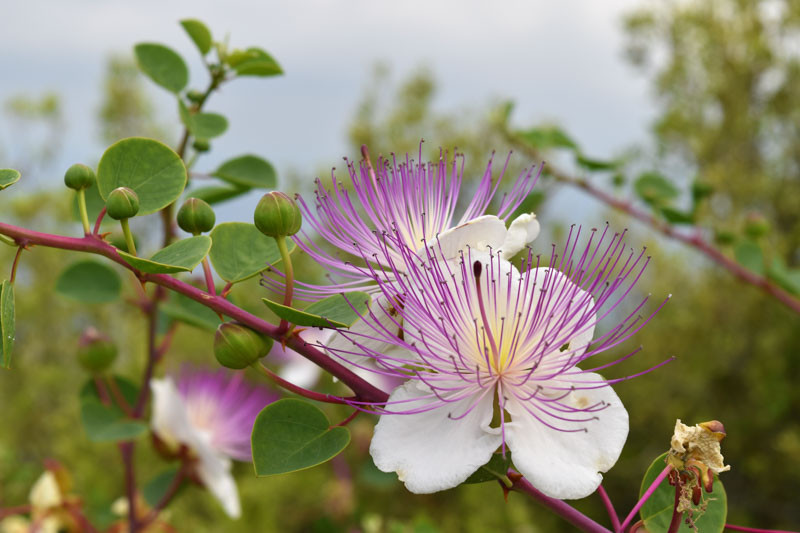
Introduction
Cancer is a multifactorial disease characterized by uncontrolled cell proliferation, resistance to apoptosis, oxidative stress imbalance, inflammation, and dysregulated signaling pathways. Increasing attention has been given to plant-derived phytochemicals that can target multiple stages of carcinogenesis. Among medicinal plants, Capparis spinosa L. (caper bush) has emerged as a significant source of bioactive compounds with anticancer potential, particularly due to its rich content of polyphenols and flavonoids.
Phytochemical profile of caper bush
The anticancer potential of Capparis spinosa is largely attributed to its diverse phytochemical composition, which includes:
- Flavonoids: Quercetin derivatives, rutin, kaempferol glycosides, isorhamnetin
- Phenolic acids: Caffeic acid, ferulic acid, chlorogenic acid, gallic acid
- Other constituents: Glucosinolates, alkaloids, carotenoids
These compounds are abundant in different plant parts such as buds, leaves, fruits, and roots. Flavonoid glycosides like rutin (quercetin-3-O-rutinoside) are among the most widely reported active constituents and are strongly associated with antioxidant and anticancer activity.1
Role of polyphenols in anticancer activity
Polyphenols from Capparis spinosa exert anticancer effects through multiple biochemical and molecular mechanisms:
Antioxidant and DNA-protective effects:
Polyphenols neutralize reactive oxygen species (ROS), reducing oxidative DNA damage that can trigger carcinogenesis. By stabilizing cellular redox balance, they help prevent mutation accumulation and tumor initiation. High flavonoid content in caper extracts contributes significantly to this antioxidant defense system.2
Regulation of cell proliferation:
Polyphenolic compounds can interfere with cancer cell cycle progression, particularly at G0/G1 and G2/M checkpoints. This leads to inhibition of uncontrolled cellular division and suppression of tumor growth.
Induction of apoptosis:
Flavonoids such as quercetin activate intrinsic apoptotic pathways by regulating mitochondrial membrane potential, increasing pro-apoptotic proteins (Bax), and decreasing anti-apoptotic proteins (Bcl-2). This results in programmed cell death of malignant cells.
Anti-inflammatory action:
Chronic inflammation promotes tumor development through NF-κB activation and cytokine release. Polyphenols from Capparis spinosa suppress inflammatory mediators such as TNF-α, IL-6, and COX-2, thereby reducing the tumor-promoting inflammatory microenvironment.
Anti-angiogenic and anti-metastatic effects:
Flavonoids inhibit vascular endothelial growth factor (VEGF) signaling, limiting tumor angiogenesis. They also suppress matrix metalloproteinases (MMPs), reducing cancer cell invasion and metastasis.
Key bioactive flavonoids
Quercetin:
A major flavonoid in Capparis spinosa, quercetin exhibits strong anticancer activity through modulation of PI3K/Akt, MAPK, and p53 signaling pathways. It also enhances oxidative stress–mediated cancer cell apoptosis.
Rutin:
Rutin demonstrates antioxidant, anti-proliferative, and anti-inflammatory effects. It protects normal cells while selectively targeting malignant cell pathways.
Kaempferol and Isorhamnetin:
These flavonoids contribute to cell cycle arrest, apoptosis induction, and suppression of tumor cell migration.
Phenolic acids and synergistic effects
Phenolic acids such as chlorogenic and caffeic acid enhance the overall anticancer potential by improving antioxidant capacity and working synergistically with flavonoids. The combined action of these compounds increases therapeutic efficiency through multi-target interactions.
Therapeutic Implications
The polyphenol-rich profile of Capparis spinosa suggests potential applications in:
- Cancer chemoprevention
- Adjunct therapy with conventional chemotherapy
- Oxidative stress–related tumor prevention
- Development of plant-based anticancer formulations
However, most evidence remains preclinical, and clinical validation is still limited.
Conclusion
Bioactive polyphenols and flavonoids in Capparis spinosa play a central role in its anticancer activity. Through antioxidant protection, apoptosis induction, anti-inflammatory effects, and inhibition of angiogenesis and metastasis, these compounds act on multiple cancer-related pathways. The synergistic interaction between flavonoids and phenolic acids enhances its therapeutic potential, making caper bush a promising candidate for future anticancer drug development. Further clinical studies are required to translate these findings into evidence-based therapeutic applications.3
Reference:
- Zhang H, Ma ZF. Phytochemical and Pharmacological Properties of Capparis spinosa as a Medicinal Plant. Nutrients. 2018;10(2):116. Published 2018 Jan 24. doi:10.3390/nu10020116 https://pmc.ncbi.nlm.nih.gov/articles/PMC5852692/
- Annaz H, Sane Y, Bitchagno GTM, et al. Caper (Capparis spinosa L.): An Updated Review on Its Phytochemistry, Nutritional Value, Traditional Uses, and Therapeutic Potential. Front Pharmacol. 2022;13:878749. Published 2022 Jul 22. doi:10.3389/fphar.2022.878749 https://pmc.ncbi.nlm.nih.gov/articles/PMC9353632/
- Oraibi AI, Dawood AH, Trabelsi G, Mahamat OB, Chekir-Ghedira L, Kilani-Jaziri S. Antioxidant activity and selective cytotoxicity in HCT-116 and WI-38 cell lines of LC-MS/MS profiled extract from Capparis spinosa L. Front Chem. 2025;13:1540174. Published 2025 Apr 10. doi:10.3389/fchem.2025.1540174 https://pmc.ncbi.nlm.nih.gov/articles/PMC12018432/