
Introduction
The skin serves as a vital protective barrier between the internal physiological environment and external physical, chemical, and microbial factors. Maintenance of skin integrity is essential not only for physiological homeostasis but also for aesthetic appearance and psychosocial well-being.
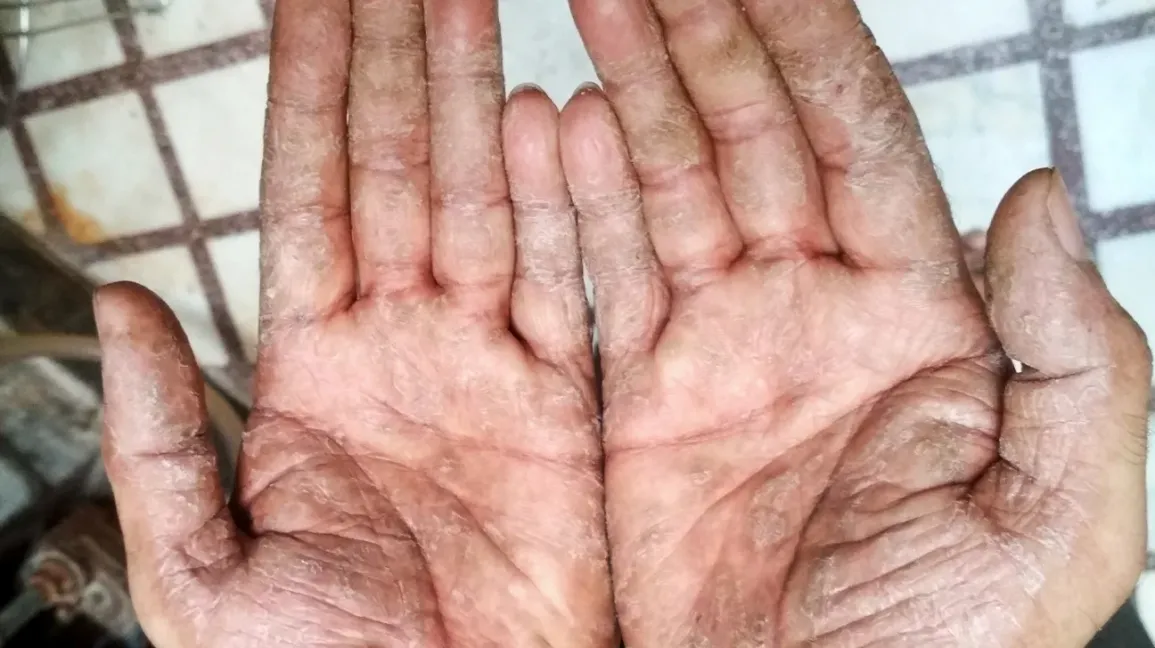
Palmo-plantar psoriasis is a chronic, inflammatory, and functionally disabling variant of psoriasis, predominantly affecting the palms and soles. It is considered the second most common form of psoriasis after chronic plaque psoriasis and is often associated with significant impairment in daily activities due to pain, fissuring, and hyperkeratosis. From a conventional dermatological perspective, palmo-plantar psoriasis is frequently recalcitrant to standard therapeutic interventions and exhibits a relapsing–remitting course.
Clinical features and disease burden
Patients commonly present with:
- Deep fissuring and hyperkeratotic plaques on palms and soles
- Painful cracking and bleeding lesions
- Burning sensation and tenderness (tivra vedana)
- Functional limitation affecting walking, grasping, and occupational activities
These manifestations significantly reduce quality of life and contribute to psychological distress and social impairment.
Ayurvedic perspective of Vipadika (palmo-plantar psoriasis)
In Ayurvedic dermatology, palmo-plantar psoriasis is correlated with Vipadika, a subtype of Kushta. Classical Ayurvedic texts describe Kushta as a broad category encompassing diverse dermatological disorders. Vipadika is characterized by:
- Cracks and fissures in palms and soles (pani-pada sphutana)
- Severe pain (tivra vedana)
- Dryness and roughness of affected skin
Although considered curable in Ayurvedic literature, its chronic and recurrent nature poses therapeutic challenges for long-term management.
Vipadikahara Ghrita–Taila: classical formulation overview
Vipadikahara Ghrita–Taila is a classical Ayurvedic medicated formulation described in Charaka Samhita under the context of Kushta Chikitsa. It is traditionally used for the management of Vipadika due to its skin-reparative and analgesic properties.
This formulation is prepared in a lipid base (ghrita and taila), which enhances dermal penetration and facilitates sustained therapeutic action at the site of lesion.
Therapeutic relevance in palmo-plantar psoriasis
The formulation is considered therapeutically relevant due to its proposed actions:
- Emollient effect reducing dryness and fissuring
- Anti-inflammatory activity reducing erythema and pain
- Wound-healing and tissue regeneration support
- Restoration of skin barrier function
- Reduction in hyperkeratotic changes
These effects collectively contribute to symptomatic relief and improved skin integrity in palmo-plantar psoriasis.
Clinical significance and limitations
Palmo-plantar psoriasis is not life-threatening; however, its chronicity, visible lesions, and functional impairment make it clinically significant. The recurrent nature of the disease often leads to long-term therapeutic dependency and reduced patient compliance in conventional management systems.
From an Ayurvedic standpoint, Vipadikahara Ghrita–Taila represents a topical therapeutic strategy aimed at symptom control, barrier restoration, and recurrence reduction. However, systematic clinical validation through controlled trials remains limited.
Ingredients of Vipadikahara Ghrita-Taila
In this preparation, two types of sneha dravyas (unctuous media), namely ghrita (ghee) and taila (oil), are employed for sneha paka. Since both ghrita and taila are used in combination, this formulation is classified as yamaka sneha paka, indicating a synergistic preparation involving two lipid bases.
According to classical principles of sneha kalpana, the sneha dravya is generally taken in a proportion four times that of kalka dravya (herbal paste component), which serves as the primary active matrix for extraction of phytoconstituents. In yamaka sneha preparation, ghrita and taila are maintained in equal proportion to ensure balanced physicochemical properties, enhanced bioavailability, and optimized therapeutic action.
After completion of the paka process, prakshepa dravyas (post-cooking additives) are incorporated, typically in a proportion of one-eighth of the total sneha quantity, to preserve volatile constituents and enhance stability and therapeutic efficacy.
In this formulation, sarjarasa and madhucchishta are added in equal quantities as prakshepa dravyas, contributing resinous and waxy bioactive components that improve wound-healing, anti-inflammatory, and barrier-protective properties of the final preparation.
Pharmacological profile and uses related to psoriasis
|
Ayurveda name / English name |
Pharmacological actions as per Ayurveda classics |
|
Sarjarasa (White dammar resin) |
Kandughna (anti-pruritic), Kusthaghna (anti-dermatological), Vrana ropana (wound healing), Sandhaniya (tissue healing), Jantughna (antimicrobial), Vipadikahara (useful in palmo-plantar psoriasis), Varnya (improves skin tone) |
|
Madhuchishta (Beeswax) |
Vranashothahara (anti-inflammatory), Jantughna (antiseptic), Vrana ropana (wound healing), Sandhaniya (tissue regeneration), Kusthahara (skin disease management), Vipadikahara (useful in palmo-plantar psoriasis), Vataraktahara (useful in gout-like conditions) |
Conclusion
Vipadikahara Ghrita–Taila is a classical Ayurvedic topical formulation described in the Charaka Samhita for the management of Vipadika and other Kushta-related skin disorders. The formulation comprises ten bioactive ingredients with documented therapeutic properties that directly or indirectly modulate key pathological mechanisms involved in dermatological diseases, including inflammation, microbial colonization, impaired wound healing, and disrupted skin barrier function.
The present review suggests that Vipadikahara Ghrita–Taila may exert its therapeutic effects in palmo-plantar psoriasis through enhanced dermal penetration, pilosebaceous unit uptake, and cutaneous biotransformation of phytoconstituents, leading to localized anti-inflammatory, keratolytic, and barrier-restorative actions.
Overall, the evidence highlights the potential of this classical formulation as a multitarget dermatological intervention. However, there remains a substantial need for well-designed multicentric randomized clinical trials to generate robust evidence and validate its efficacy, safety, and standardization for integration into evidence-based dermatological practice.1
References:
- Singh D, Renu, Nath R, Mandal SK. CRITICAL ANALYSIS ON ‘VIPADIKAHARA GHRITA-TAILA’-A CLASSICAL MEDICATION FOR VIPADIKA(PALMO-PLANTAR PSORIASIS). World Journal of Pharmaceutical Research. Vol 8, Issue 12, 2019. https://www.researchgate.net/publication/337532289_CRITICAL_ANALYSIS_ON_'VIPADIKAHARA_GHRITA-TAILA'-A_CLASSICAL_MEDICATION_FOR_VIPADIKAPALMO-PLANTAR_PSORIASIS