
Introduction
Raktamokshana is described by Sushruta as a specialized purification therapy for diseases arising from vitiated blood. The procedure helps reduce inflammatory burden, improve local circulation, and remove pathological factors contributing to chronic disease. However, successful treatment extends beyond the procedure itself and requires measures that promote tissue repair and systemic balance.
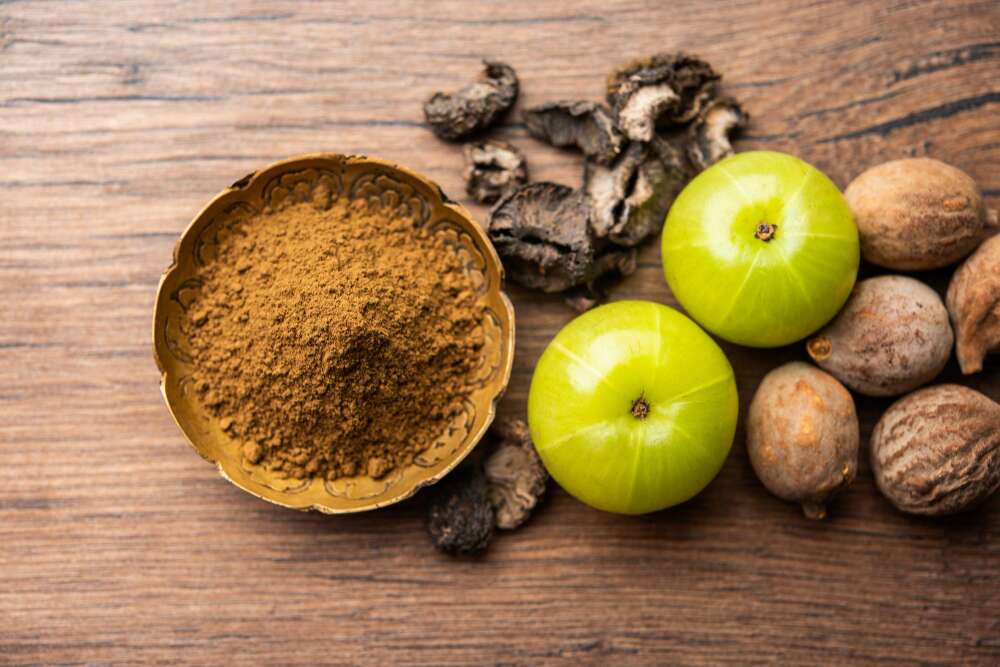
Triphala is among the most frequently prescribed Ayurvedic formulations for post-purification care.1 Owing to its rejuvenative (Rasayana) properties and favorable safety profile, it is used to support digestion, metabolism, immunity, and tissue regeneration. Its broad pharmacological activities make it particularly suitable for patients recovering from Raktamokshana.
Composition and pharmacological properties
Haritaki (Terminalia chebula):
Haritaki contains tannins, chebulagic acid, and gallic acid that exhibit antioxidant, antimicrobial, and anti-inflammatory activities. It supports gastrointestinal health and promotes detoxification, which is important for preventing re-accumulation of pathological metabolites.
Bibhitaki (Terminalia bellirica):
Bibhitaki possesses antioxidant and immunomodulatory properties. It contributes to tissue protection and helps maintain metabolic balance during the recovery phase.
Amalaki (Phyllanthus emblica):
Amalaki is rich in vitamin C, emblicanin, gallic acid, and ellagic acid. It provides potent antioxidant effects, supports collagen synthesis, enhances immunity, and promotes tissue repair.
Role in post-raktamokshana care
Restoration of oxidative balance:
Inflammatory disorders associated with Raktadushti often involve increased oxidative stress. Triphala's polyphenols and tannins neutralize reactive oxygen species and protect tissues from oxidative injury, thereby supporting recovery after bloodletting.
Anti-inflammatory activity:
Studies have demonstrated that Triphala suppresses inflammatory mediators such as TNF-α, IL-1β, and COX-2. This helps reduce residual inflammation and contributes to long-term disease control.
Support for tissue healing:
Triphala promotes fibroblast proliferation, collagen synthesis, and wound contraction. These actions facilitate healing at sites affected by chronic inflammation, ulcers, or dermatological lesions commonly treated with Raktamokshana.
Immunomodulatory effects:
Balanced immune function is essential in preventing recurrence of inflammatory and autoimmune disorders. Triphala helps regulate immune responses without causing excessive immunosuppression, thereby supporting physiological homeostasis.
Maintenance of digestive and metabolic health:
Ayurveda emphasizes the importance of proper digestion (Agni) in preventing disease recurrence. Triphala improves digestive function and assists in the elimination of metabolic waste products (Ama), thereby complementing the detoxifying effects of Raktamokshana.
Anticancer effect:
Triphala is an antioxidant-rich herbal formulation and possesses diverse beneficial properties. It is a widely prescribed Ayurvedic drug and is used as a colon cleanser, digestive, diuretic, and laxative. Cancer is a major cause of death, and globally studies are being conducted to prevent cancer or to develop effective nontoxic therapeutic agents. Experimental studies in the past decade have shown that Triphala is useful in the prevention of cancer and that it also possesses antineoplastic, radioprotective and chemoprotective effects.2
Clinical applications
Triphala is commonly prescribed following Raktamokshana in:
- Psoriasis (Kitibha Kushtha)
- Eczema (Vicharchika)
- Acne vulgaris (Yuvanapidika)
- Urticaria (Sheetapitta)
- Chronic wounds and ulcers
- Gout (Vatarakta)
- Rheumatoid arthritis (Amavata)
- Chronic inflammatory skin disorders
It may be administered as Churna, Kwatha, tablets, or incorporated into polyherbal formulations depending on the clinical condition.
Conclusion
Triphala is a valuable Ayurvedic formulation for post-Raktamokshana care due to its antioxidant, anti-inflammatory, immunomodulatory, and wound-healing properties. By supporting tissue regeneration, maintaining digestive health, regulating immune responses, and preserving the quality of Rakta Dhatu, Triphala complements the therapeutic benefits of bloodletting procedures. Contemporary scientific evidence increasingly validates its traditional use, making it an important component of integrative Ayurvedic management strategies.
Reference:
- Peterson CT, Denniston K, Chopra D. Therapeutic Uses of Triphala in Ayurvedic Medicine. J Altern Complement Med. 2017;23(8):607-614. doi:10.1089/acm.2017.0083 https://pmc.ncbi.nlm.nih.gov/articles/PMC5567597/
- Baliga MS. Triphala, Ayurvedic formulation for treating and preventing cancer: a review. J Altern Complement Med. 2010 Dec;16(12):1301-8. doi: 10.1089/acm.2009.0633. PMID: 21138390. https://pubmed.ncbi.nlm.nih.gov/21138390/