
Introduction
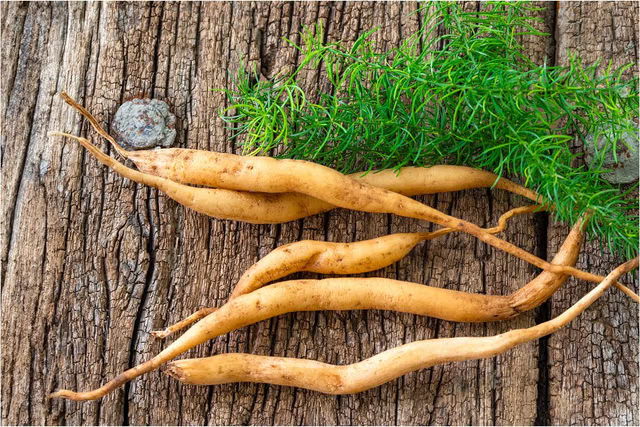
Women's reproductive health encompasses menstrual well-being, fertility, pregnancy, lactation, and menopausal health, all of which are influenced by complex hormonal and physiological changes throughout life. Hormonal imbalances, menstrual disorders, infertility, stress-related reproductive dysfunction, and menopausal symptoms can significantly affect quality of life and overall health. Ayurveda recognizes Shatavari (Asparagus racemosus) as one of the foremost herbs for female reproductive wellness, earning it the title “Queen of Ayurvedic Herbs.” Classified as a Rasayana and Stanyajanana (galactagogue), Shatavari has traditionally been used to support fertility, regulate menstrual function, promote healthy pregnancy, enhance lactation, and alleviate menopausal symptoms. Ayurveda places particular emphasis on maintaining the health of Artava (female reproductive tissue) and Yoni (reproductive system), and Shatavari is regarded as a key herb for nourishing and rejuvenating these systems.1 Modern pharmacological research has identified steroidal saponins, particularly shatavarins, along with flavonoids and polyphenols, as major bioactive constituents responsible for its adaptogenic, phytoestrogenic, antioxidant, immunomodulatory, and reproductive-supportive effects. Increasing scientific evidence supports many of its traditional applications, highlighting its potential role in promoting hormonal balance, enhancing reproductive health, supporting lactation, and improving quality of life across different stages of a woman’s reproductive lifespan.
Ayurvedic perspective
Shatavari is characterized by:
- Madhura and Tikta Rasa (sweet and bitter taste)
- Guru and Snigdha Guna (heavy and unctuous qualities)
- Sheeta Virya (cool potency)
- Madhura Vipaka
- Rasayana (rejuvenative)
- Balya (strength-promoting)
- Stanyajanana (promotes lactation)
- Vata-Pitta Shamaka
These properties make Shatavari particularly beneficial for nourishing reproductive tissues and maintaining hormonal balance.
Phytochemical constituents
Major bioactive compounds include:
- Shatavarin I–IV (steroidal saponins)
- Sarsasapogenin
- Racemosol
- Isoflavones
- Flavonoids
- Polyphenols
These constituents contribute to its phytoestrogenic, antioxidant, and adaptogenic activities.
Role in women's reproductive health
Menstrual health:
Shatavari is traditionally used to support regular menstrual cycles and alleviate menstrual discomfort. Its hormone-modulating properties may help maintain reproductive balance and reduce symptoms associated with menstrual irregularities.
Fertility support:
Ayurvedic texts describe Shatavari as a Garbhasthapaka herb that nourishes reproductive tissues and promotes fertility. Studies suggest that it may improve reproductive function through antioxidant and endocrine-modulating mechanisms.
Pregnancy support:
Shatavari is traditionally administered during pregnancy to support maternal health, nourish tissues, and maintain reproductive well-being. Its antioxidant properties may help protect against physiological stress during pregnancy.
Lactation enhancement:
One of the most established traditional uses of Shatavari is as a galactagogue. Clinical studies have demonstrated increased prolactin levels and improved breast milk production in lactating mothers.
Menopausal health:
Phytoestrogenic compounds present in Shatavari may help alleviate menopausal symptoms such as hot flashes, mood disturbances, sleep difficulties, and vaginal dryness while supporting overall well-being.
Mechanisms of action
Phytoestrogenic activity:
Shatavari contains steroidal saponins that may interact with estrogen receptors, contributing to hormonal balance and reproductive support.
Adaptogenic effects:
Chronic stress negatively impacts reproductive health. Shatavari acts as an adaptogen, helping regulate physiological responses to stress and supporting endocrine function.
Antioxidant protection:
Oxidative stress is implicated in infertility, reproductive aging, and menopausal symptoms. Shatavari's antioxidant constituents help protect reproductive tissues from oxidative damage.
Immunomodulatory activity:
Research indicates that Shatavari may modulate immune responses and support reproductive health through anti-inflammatory mechanisms.
Clinical applications
- Menstrual irregularities
- Dysmenorrhea
- Female infertility
- Pregnancy support
- Lactation insufficiency
- Perimenopausal and menopausal symptoms
- Reproductive debility
Conclusion
Shatavari (Asparagus racemosus) remains one of Ayurveda's most revered herbs for women's reproductive health.2 Its traditional designation as the "Queen of Ayurvedic Herbs" is supported by extensive evidence demonstrating reproductive, hormonal, adaptogenic, antioxidant, and galactagogue activities. From menstrual health and fertility support to pregnancy, lactation, and menopause, Shatavari offers a comprehensive approach to female reproductive wellness. Continued clinical research will further clarify its therapeutic potential and facilitate its integration into evidence-based women's healthcare.
Reference:
- Alok S, Jain SK, Verma A, Kumar M, Mahor A, Sabharwal M. Plant profile, phytochemistry and pharmacology of Asparagus racemosus (Shatavari): A review. Asian Pac J Trop Dis. 2013;3(3):242-251. doi:10.1016/S2222-1808(13)60049-3 https://pmc.ncbi.nlm.nih.gov/articles/PMC4027291/
- Oyovwi MO, Chijiokwu EA, Ben-Azu B, Ugwuishi EW, Jeroh E. Shatavari (Asparagus racemosus): A Promising Ally for Fertility. Curr Nutr Rep. 2025 Sep 20;14(1):108. doi: 10.1007/s13668-025-00694-5. PMID: 40974515. https://pubmed.ncbi.nlm.nih.gov/40974515/