
Introduction
Male infertility is a multifactorial disorder characterized by abnormalities in sperm count, motility, morphology, or reproductive endocrine function. Psychological stress and neuroendocrine disturbances can further impair fertility by disrupting the hypothalamic–pituitary–gonadal (HPG) axis.
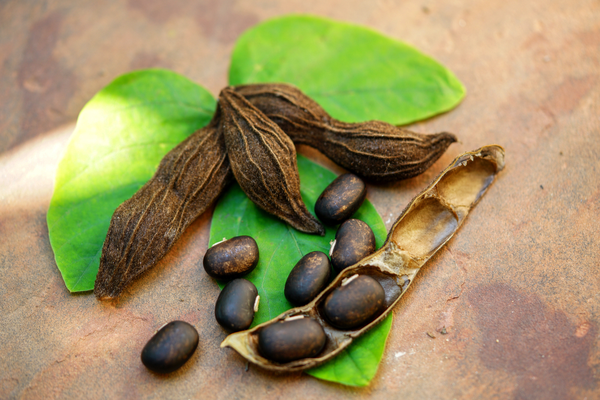
Ayurveda recognizes reproductive health as dependent on the integrity of Shukra Dhatu. Kaunch Beej is one of the most extensively described Vajikarana drugs for improving fertility and sexual function.1 Contemporary studies have demonstrated significant effects on semen quality, reproductive hormones, and stress-related infertility.
Ayurvedic perspective
Kaunch Beej is described as:
- Madhura and Tikta Rasa
- Guru and Snigdha Guna
- Ushna Virya
- Madhura Vipaka
- Vajikarana (aphrodisiac)
- Balya (strength-promoting)
- Rasayana (rejuvenative)
- Shukrala (enhances semen quality)
These properties support its traditional use in infertility, reduced libido, and reproductive debility.
Phytochemical constituents
The major bioactive compounds include:
- L-DOPA (levodopa)
- Alkaloids (mucunine, mucunadine)
- Flavonoids
- Tannins
- Saponins
- Phenolic antioxidants
Among these, L-DOPA is considered the principal pharmacologically active constituent.
Dopaminergic regulation
Role of L-DOPA:
L-DOPA serves as the direct precursor of dopamine, a neurotransmitter involved in motivation, mood regulation, sexual behavior, and neuroendocrine control.
Following administration, L-DOPA increases central dopamine levels, which may:
- Enhance libido and sexual motivation
- Improve neuroendocrine regulation
- Influence reproductive hormone secretion
- Reduce stress-related reproductive dysfunction
Effects on the hypothalamic–pituitary–gonadal axis:
Dopamine plays an important role in regulating gonadotropin release. By supporting dopaminergic signaling, Kaunch Beej may positively influence:
- Luteinizing hormone (LH)
- Follicle-stimulating hormone (FSH)
- Testosterone production
- Spermatogenesis
This neuroendocrine modulation contributes to improved reproductive function.
Role in male infertility
Improvement in semen quality:
Clinical studies have demonstrated that Mucuna pruriens supplementation can improve:
- Sperm concentration
- Sperm motility
- Semen volume
- Sperm morphology
These effects have been observed particularly in infertile men with oligospermia and stress-related infertility.2
Antioxidant protection:
Oxidative stress is a major contributor to sperm dysfunction and DNA damage. Kaunch Beej enhances antioxidant defenses by increasing levels of:
- Superoxide dismutase (SOD)
- Catalase
- Glutathione
This reduces oxidative injury to spermatozoa and improves fertility potential.
Hormonal modulation:
Studies have reported improvements in serum testosterone, LH, and dopamine-related neuroendocrine parameters following Kaunch Beej supplementation, supporting reproductive hormone balance.
Stress reduction:
Psychological stress adversely affects fertility through increased cortisol and oxidative stress. Kaunch Beej has been shown to reduce stress markers and improve overall reproductive function in infertile men.
Clinical applications
Kaunch Beej is commonly used in:
- Male infertility
- Oligospermia
- Asthenozoospermia
- Reduced libido
- Stress-related reproductive dysfunction
- Erectile dysfunction (adjunctive support)
- General reproductive debility
It is frequently incorporated into classical Vajikarana formulations.
Safety profile
When used in recommended therapeutic doses and properly processed according to Ayurvedic principles, Kaunch Beej is generally well tolerated. Excessive intake may occasionally produce gastrointestinal discomfort, headache, or dopaminergic side effects.
Conclusion
Kaunch Beej (Mucuna pruriens) is a valuable Vajikarana Rasayana with significant potential in male infertility and reproductive health. Its unique L-DOPA content supports dopaminergic regulation, neuroendocrine balance, and reproductive hormone function, while its antioxidant properties protect sperm from oxidative damage. Contemporary clinical evidence supports its traditional Ayurvedic use as a fertility-enhancing herb, making it an important component of integrative approaches to male reproductive disorders.
Reference:
- Shukla KK, Mahdi AA, Ahmad MK, Shankhwar SN, Rajender S, Jaiswar SP. Mucuna pruriens improves male fertility by its action on the hypothalamus-pituitary-gonadal axis. Fertil Steril. 2009 Dec;92(6):1934-40. doi: 10.1016/j.fertnstert.2008.09.045. Epub 2008 Oct 29. PMID: 18973898. https://pubmed.ncbi.nlm.nih.gov/18973898/
- Shukla KK, Mahdi AA, Ahmad MK, Jaiswar SP, Shankwar SN, Tiwari SC. Mucuna pruriens Reduces Stress and Improves the Quality of Semen in Infertile Men. Evid Based Complement Alternat Med. 2010;7(1):137-144. doi:10.1093/ecam/nem171 https://pmc.ncbi.nlm.nih.gov/articles/PMC2816389/