
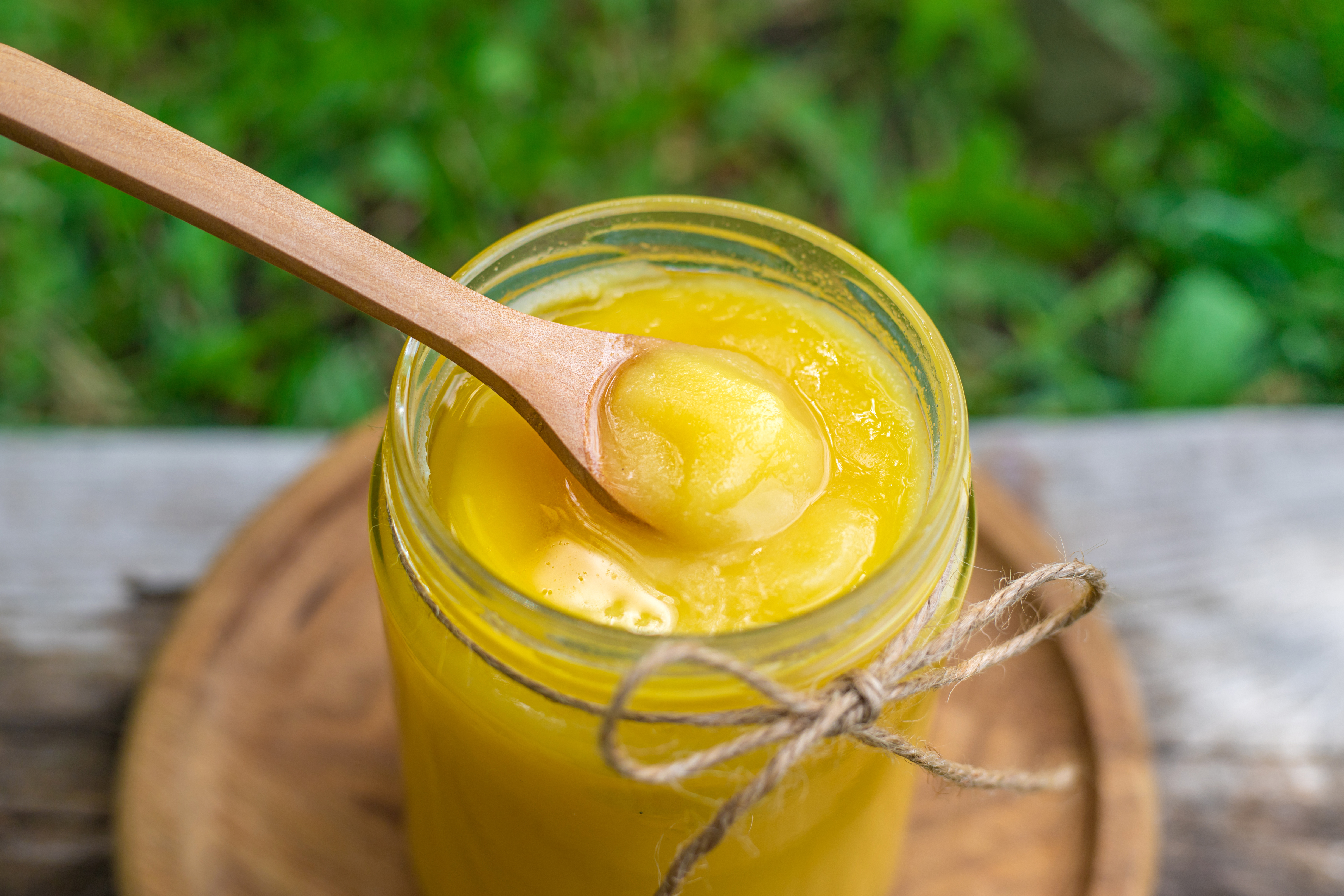
Ghee, a clarified butter derived from milk, holds considerable cultural, nutritional, and medicinal significance in India. During its preparation, water and solid milk constituents are removed through heating, resulting in a stable product with a prolonged shelf life. It has been used in traditional medicine since ancient times, particularly for wound management. According to Ayurvedic principles, ghee can be stored for extended periods, with its quality and therapeutic properties believed to improve as it ages.1
In Ayurveda, ghee is valued for its nourishing, rejuvenating, and therapeutic properties and is frequently used as a carrier in polyherbal formulations known as Ghritas. Although its traditional applications are extensive, contemporary scientific investigations into its functional benefits remain relatively limited. Emerging research has examined its potential effects on cognitive, gastrointestinal, immune, cardiovascular, dermatological, and other aspects of health.
Ghee has been reported to contain short-chain fatty acids (SCFAs), medium-chain fatty acids (MCFAs), long-chain fatty acids (LCFAs), and very-long-chain fatty acids (VLCFAs). Among these, butyric acid (BA) has been identified as the sole SCFA, palmitic acid (PA) as the predominant saturated fatty acid, and oleic acid (OA) as the principal unsaturated fatty acid.2
Therapeutic properties and health benefits of ghee
Cognitive and neuroprotective properties:
- Cognitive health represents one of the most frequently documented therapeutic applications of ghee in Ayurvedic literature.
- Benefits involving memory, intellect, and mental clarity have been described, alongside traditional applications in neurological and psychiatric conditions.2
- Potential neuroprotective effects have been associated with short-chain fatty acids (SCFAs), omega-3 fatty acids, and conjugated linoleic acids (CLAs). SCFAs may exert anti-inflammatory effects on microglia, while DHA, EPA, and CLAs have been investigated for their contributions to cognitive function and brain health.
- Ghee-based formulations, including Kalyanaka Ghrita, Sarasvata Ghrita, Kushmanda Ghrita, and Brahmi Ghrita, have demonstrated promising findings involving memory, antioxidant activity, inflammatory markers, and neuroprotection in preliminary studies.
Gastrointestinal health:
- Its traditional digestive applications have been described, with camel ghee being particularly recognised in Ayurvedic literature.
- SCFAs may support intestinal barrier integrity, digestion, and gut immunity. Medium-chain triglycerides (MCTs), CLAs, SCFAs, and omega-3 polyunsaturated fatty acids (PUFAs) have also been associated with energy provision and satiety.
- Additionally, interactions between CLAs and gut microbiota may promote SCFA production. Limited research has suggested that incorporating ghee during rice preparation may influence postprandial glycaemic responses.
Rejuvenating and immunomodulatory properties:
- Ghee is classified as a Rasayana in Ayurveda, reflecting its traditional application in nourishment, rejuvenation, immunity enhancement, and healthy ageing.
- Butyric acid has been associated with intestinal immune regulation and T-cell activity, while omega-3 fatty acids have demonstrated immunomodulatory effects in inflammatory and autoimmune conditions.
- Ghee-based formulations, including Swarna Bindu Prashana and Amalaki Rasayana, have also demonstrated immunomodulatory potential in preliminary investigations.
Cardiovascular health:
In recent times, modern scientific publications on ghee have investigated cardiovascular health, with conflicting findings.
- Its saturated fatty acid and cholesterol content has raised concerns regarding dyslipidaemia and cardiovascular disease (CVD) risk. Cholesterol oxidation products formed during heating have also been investigated for their potential atherogenic effects.
- Conversely, some studies have reported favourable changes in HDL cholesterol, triglycerides, and other lipid parameters following ghee consumption.
- Antioxidants, including vitamins A and E, carotenoids, and phospholipids, have also been proposed to contribute to its biological effects. However, other investigations have demonstrated increases in LDL cholesterol, triglycerides, ApoB, and non-HDL cholesterol.
- Consequently, cardiovascular benefits cannot be established, and moderate consumption should be considered within the context of overall dietary fat intake.
Anti-tumour and dermatological properties:
- Vitamins A, E, and K present in ghee have been investigated for their antioxidant and potential anti-tumour activities. Experimental studies have reported modulation of COX-2 and PPAR-γ expression and alterations in enzymes involved in carcinogen metabolism. However, evidence remains preliminary, and both favourable and unfavourable cancer associations have been reported.
- In dermatology, ghee and herbal ghee preparations have been investigated for antioxidant, antibacterial, antiseptic, and wound-healing properties.
- Jatyadi Ghrita has demonstrated improvements in wound contraction, re-epithelialisation, and collagen deposition. Preparations containing ghee, honey, turmeric, Guduchi, and other botanicals have also shown potential in experimental wound healing and selected dermatological conditions.
Ocular and bone health:
- Ghee-based preparations have traditionally been used in Ayurvedic ophthalmic therapies, including Tarpana and Akshitarpana.
- Experimental studies have investigated their potential in ocular drug delivery, cataract, glaucoma, myopia, and dry eye syndrome. Similarly, Panchatikta Ghrita has demonstrated potential anti-osteoporotic effects in experimental studies, with improvements in bone mineral density, calcium balance, and bone-related biomarkers.
Conclusion
Ghee occupies an important position in Ayurveda because of its nutritional, rejuvenating, and therapeutic applications. Emerging research suggests potential benefits involving cognitive function, gastrointestinal health, immune modulation, wound healing, and ocular health. Nevertheless, cardiovascular findings remain inconsistent, while anti-tumour and bone-protective effects require further validation. Its use should therefore be guided by individual nutritional requirements and sound clinical evidence rather than traditional claims alone.3
References:
- Udwadia TE. Ghee and honey dressing for infected wounds. Indian J Surg. 2011;73(4):278-283. doi:10.1007/s12262-011-0240-7 https://pmc.ncbi.nlm.nih.gov/articles/PMC3144338/
- Chi F, Tan Z, Wang Q, et al. Tibetan Butter and Indian Ghee: A Review on Their Production and Adulteration. Agriculture. 2024; 14(9):1533 https://www.mdpi.com/2077-0472/14/9/1533
- Kataria D, Singh G. Health benefits of ghee: Review of Ayurveda and modern science perspectives. J Ayurveda Integr Med. 2024;15(1):100819. doi:10.1016/j.jaim.2023.100819 https://pmc.ncbi.nlm.nih.gov/articles/PMC10789628/#sec4