
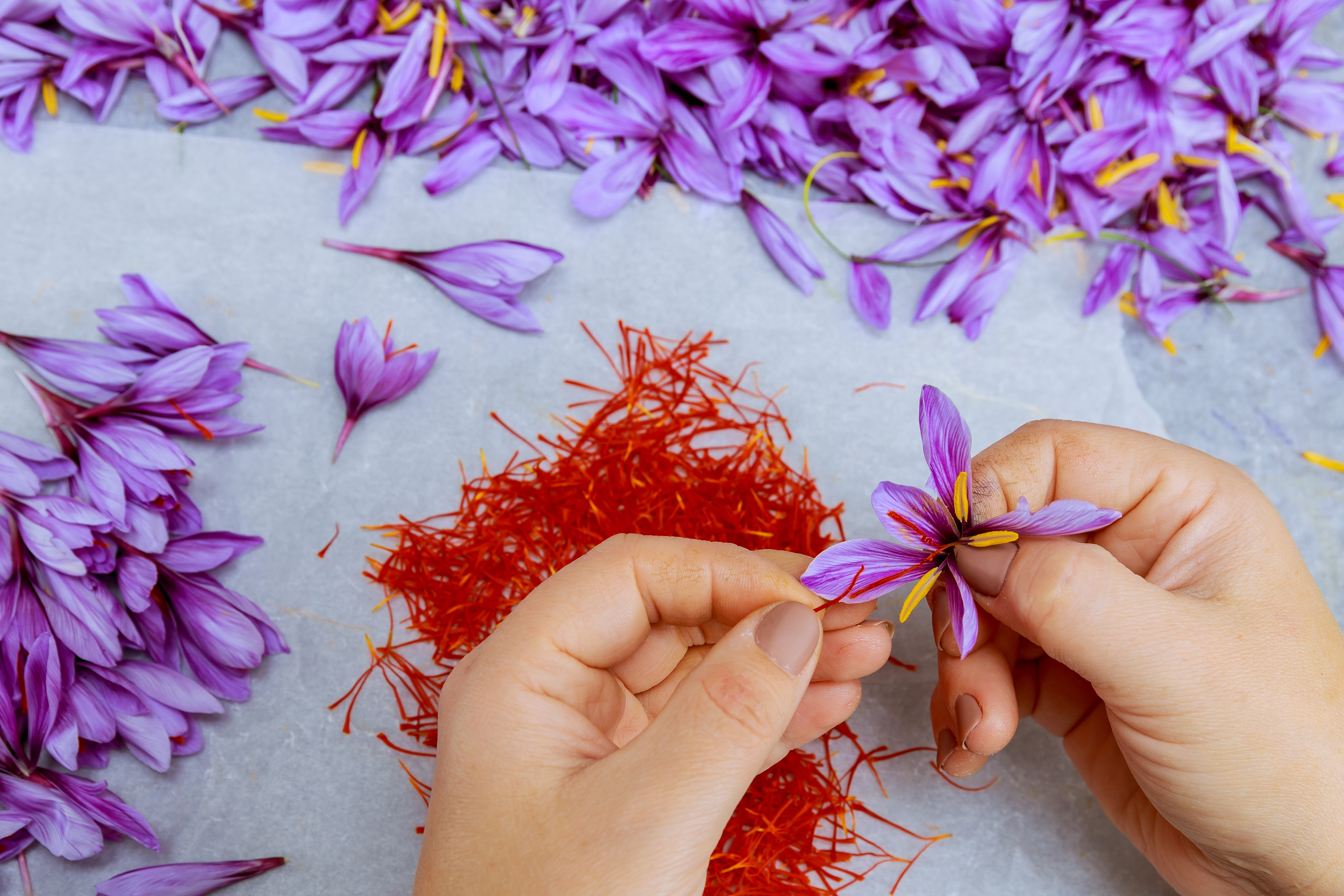
Crocus species are primarily distributed across North Africa, Southern and Central Europe, and Western Asia. Many species are cultivated as ornamental plants in gardens and parks, whereas Crocus sativus L. (saffron) is the only species cultivated for culinary use. Saffron has a long history of use, not only as a spice but also for its medicinal and colouring properties.
- Culinary and preservative properties: Saffron is valued for its distinctive flavour and colour. Its antimicrobial and antioxidant activities may contribute to food preservation.
- Bioactive compounds: Several medicinal and health-promoting properties attributed to saffron are associated with its bioactive constituents.
- Antioxidant and neuroactive potential: Safranal exhibits antioxidant and free-radical-scavenging properties. It has also demonstrated anticonvulsant and antidepressant effects in preclinical models.
Traditional medicinal uses of Crocus sativus1
The traditional applications of C. sativus extend across dietary, cosmetic, and medicinal practices. Its historical uses vary across different traditional medicine systems and geographical regions.
- Traditional Persian medicine:
- General restorative use: Saffron was traditionally used as a tonic to promote overall vitality, particularly supporting the vascular and nervous systems.
- Mental health and sleep: It was incorporated into traditional formulations for depression and insomnia.
- Other traditional indications: Persian medicine also documented its use for conditions such as measles and dysentery.
Saffron continues to be regarded as an important medicinal substance in traditional Iranian medicine.
- Historical applications in ancient civilizations:
- Ancient Roman practices: Saffron was added to wine with the intention of preventing hangovers and intoxication.
- Skin and mucosal conditions: In ancient Egypt and Greece, it was used traditionally for ulcers affecting the skin and mucous membranes.
- Ocular health: Historical applications included addressing eye pain, infections, and cataracts.
- Urinary and menstrual health: Saffron was also used traditionally for certain urinary and menstrual disorders.
- Applications in Unani medicine: Saffron is traditionally recognized as a remedy for urinary and kidney infections and menstrual disorders. It is regarded as a stomachic, while preparations combining saffron with honey have traditionally been used as diuretics. Saffron is a common ingredient in preparations intended to support general physical and mental well-being.
- Anti-inflammatory and antimicrobial applications:
Traditionally, saffron has been used for a broad range of conditions based on its perceived antiseptic and anti-inflammatory properties.
- Infections and inflammation: Traditional applications include bacterial and fungal infections, inflammatory conditions, insect bites, and skin-related complaints.
- Other reported uses: Historical medicinal applications also include apoplexy, alcoholism, arthritis, diabetes, smallpox, and various gastrointestinal problems.
- Reproductive effects and safety: Saffron has traditionally been associated with uterine contractions at lower doses and generalised spasms and constriction at higher doses. These historical claims should not be interpreted as established clinical effects. Saffron use during pregnancy requires particular caution because of potential reproductive risks.
- Dermatological and cosmetic applications: Saffron has a history of use in cosmetic and traditional skin care practices.
- Skin conditions: Traditional applications include acne, erysipelas, wounds, and other skin disorders. Saffron has been recommended traditionally for conditions such as purpura, eczema, and measles.
- Musculoskeletal applications: Aqueous saffron extract, when combined with other medicinal substances, has traditionally been used for painful or dislocated joints, sprains, and fractured bones.
- Neurological and mental health applications:
Saffron has attracted interest for its traditional use in managing headaches, sleep disturbances, and mental health concerns.
- Headaches and insomnia: In Iran, boiled saffron preparations have traditionally been used for insomnia, severe headaches, and complaints involving the head and neck.
- Mood and emotional well-being: In India, saffron has been used traditionally for depression and related mental health conditions. C. sativus has been described in traditional and research literature as having mood-enhancing and anxiety-calming potential.
- Sedative applications: Saffron essential oil has traditionally been combined with olive or sesame oil for use as a sedative. The mixture is prepared by leaving the oils together for five days with periodic stirring, followed by filtration.
- Neurodegenerative conditions: Saffron flowers have been used as part of alternative therapeutic approaches for Alzheimer's disease.
- Reproductive health applications:
- Aphrodisiac use: C. sativus has traditionally been recognised as an aphrodisiac and used in formulations intended to address impotence.
- Sperm-related applications: Traditional medicine has also attributed a role to saffron in supporting sperm activation.
These applications largely reflect traditional practices and should not be interpreted as definitive evidence of clinical efficacy.
Clinical evidence2
Cardiovascular effects of C. sativus and its constituents in experimental studies:
Here is the table formatted to preserve the original information, wording, order, doses, study designs, effects, and references exactly as provided in the paper.
|
Compound |
Dose |
Possible mechanism and effect |
|
Aqueous extract |
50-00 mg/kg, p.o., 7 days |
Reduced electrical conductivity, ventricular arrhythmia, prolonging action potential duration (APD) |
|
|
2.5-10 mg/kg, i.v., 5 weeks |
Reduced mean systolic blood pressure (MSBP) |
|
Aqueous-ethanolic extract |
0.1-5.0 mg%, intracoronary |
Inhibitory effect on calcium channel |
|
|
2 g/400 ml, p.o., 6 weeks |
Activated glutathione peroxidase (GPX), decreased lipid peroxidation |
|
|
200 mg/kg, p.o., 5 weeks |
Reduced cross-section area, media thickness, and elastic lamellae of aorta, hypertension |
|
|
0.19 mg/L, intracoronary |
Decreased AV node rhythmicity, increased AVCT and FRP facilitation, and the magnitude of fatigue |
|
Crocin |
20 mg/kg, IP, 3 weeks |
Increased antioxidant systems, protected against cardiac reperfusion arrhythmias |
|
|
10-40 mg/kg, p.o., 21 days |
Antioxidant capacity, prevented cardiac dysfunction and myocardial infarction |
|
|
10-40 mg/kg, p.o., 3 weeks |
Improved cardiac dysfunction, reduced infarct size |
|
|
1 and 10 µM |
Increased bcl-2/bax ratio and expression, inhibited aortic endothelial cell apoptosis and atherosclerosis |
|
|
12.5-50 mg/kg, 4 weeks |
Reduced SBP, elevated heart rate |
|
|
60 mg/kg, i.v. |
Attenuated oxidative stress, protected organs from damages |
|
|
|
Alleviated tissue injuries, increased nuclear translocation of p65 and IkBα phosphorylation |
|
Crocetin |
25-50 mg/kg, p.o., 10 weeks |
Improved lipid profile, aortic lesion, decreased TNF-α, IL-6, MDA, increased SOD, down-regulated p38 MAPK |
|
|
1.0 μM |
Decreased AGEs-induced VSMCs migration, RAGE expression, RAGE, TNF-α, IL-6, and MMP-2/9 activities |
|
|
1 μM |
Blockade of L-type calcium channel |
|
|
0.01, 0.1 and 1 μM |
Reduced AGE-induced BEC, leukocyte adhesion to BEC, ICAM-1 protein, down-regulated MMP |
|
|
1 to 3 μM |
Reduced VEGF-induced tube formation by human umbilical vein endothelial cells (HUVECs) and migration of HRMECs, p38 and protected VE-cadherin |
|
|
50 mg/kg |
Decreased infarct size, CK-MB, MDA, and TNF-α, Increased total SOD and IL-10 |
|
|
25, 50 mg/kg, i.g., 15 days |
Improved antioxidant enzymatic activities and myocardial pathological changes |
|
|
50 and 100 mg/kg, i.g., 15 days |
Increased activity of Na+, K+-ATPase, Ca2+, Mg2+-ATPase, inhibited MMPs activity, reduced cardiac hydroxyproline |
|
|
10-50 mg/kg, p.o., 1 week |
Inhibited MAPK/MEK/ERK1/2 pathway and cardiac hypertrophy |
|
|
0.1-10 μM, p.o., 8 weeks |
Restored thoracic aorta EDR, increased vessel eNOS activity, elevated NO level |
|
|
0.1 and 1 μM |
Inhibited phosphorylation and ERK1/2activation, nuclear translocation of activated ERK1/2 |
|
|
0.01, 1 and 10 μM |
Inhibited angiotensin II-induced cell-cycle progression by arresting the cells in the G0/G1 phase and activation of ERK1/2, decreased ROS, increased SOD activity |
|
Safranal |
1-4 mg/kg, IP, 5 weeks |
Reduced MSBP, antihypertensive effects |
|
|
0.1-0.5 ml/kg |
Enhanced Akt/GSK-3β/eNOS phosphorylation, suppressed IKK-β/NF-κB expressions, apoptosis |
Anti-seizure effect in preclinical studies:
Ethanolic (0.2-2.0 g/kg, IP) extracts of C. sativus have been shown to reduce convulsant activity, onset of tonic convulsions, period of seizure using maximal electroshock seizure (MES) tests, and mortality.
Safety evaluation of saffron and its main constituents3
Recent clinical studies have evaluated the safety profile of saffron and its principal constituents. Overall, saffron has generally been associated with a limited number of well-tolerated adverse effects. The most frequently reported side effects include dizziness, dry mouth, headache, fatigue, nausea, daytime drowsiness, constipation, and sweating.
- Tolerability in clinical trials: Several clinical trials reported no adverse effects associated with saffron consumption, even at doses of 100 mg/day.
- Adverse effects associated with crocin: In a human trial, oral administration of crocin tablets at 30 mg/day (15 mg twice daily) for four weeks was associated with menometrorrhagia, dyspnoea, and agitation in three different patients. In another study involving the same daily dose administered for six weeks, decreased appetite was reported in four patients.
- Effects on coagulation parameters: It has been reported that oral administration of saffron tablets at doses of 200 or 400 mg/day for seven days did not produce any significant changes in plasma levels of selected coagulation and anticoagulation parameters, including fibrinogen, factor VII, proteins C and S, prothrombin time (PT), and partial thromboplastin time (PTT), compared with the placebo group.
- Risk of gastrointestinal bleeding: In some cases, saffron ingestion at a dose of 2 g has been associated with gastrointestinal bleeding.
- Dose-related safety considerations: Saffron doses of up to 1.5 g/day have been considered safe. However, doses of 5 g/day or more may produce toxic effects, while doses of 20 g or higher have been reported to be fatal.
Overall, these findings suggest that saffron's safety profile is influenced by the dose consumed and the duration of administration. Although clinical studies indicate good tolerability at certain doses, adverse effects and potential toxicity at higher doses warrant caution.
Conclusion
Crocus sativus (saffron) has a long history of traditional medicinal use and demonstrates promising antioxidant, cardiovascular, neuroprotective, and mood-related therapeutic potential. Clinical and preclinical findings suggest possible benefits of saffron and its bioactive constituents, including crocin, crocetin, and safranal. However, its safety depends on dosage and duration of use, highlighting the need for further rigorous clinical studies to establish its efficacy, optimal dosing, and long-term safety.
References:
- Butnariu M, Quispe C, Herrera-Bravo J, et al. The Pharmacological Activities of Crocus sativus L.: A Review Based on the Mechanisms and Therapeutic Opportunities of its Phytoconstituents. Oxid Med Cell Longev. 2022;2022:8214821. Published 2022 Feb 14. doi:10.1155/2022/8214821. http://pmc.ncbi.nlm.nih.gov/articles/PMC8860555/
- Saadat S, Ghasemi Z, Memarzia A, Behrouz S, Aslani MR, Boskabady MH. An overview of pharmacological effects of Crocus sativous and its constituents. Iran J Basic Med Sci. 2024;27(4):391-417. doi:10.22038/IJBMS.2023.73410.15950. https://pmc.ncbi.nlm.nih.gov/articles/PMC10897555/
- Zeinali M, Zirak MR, Rezaee SA, Karimi G, Hosseinzadeh H. Immunoregulatory and anti-inflammatory properties of Crocus sativus (Saffron) and its main active constituents: A review. Iran J Basic Med Sci. 2019;22(4):334-344. doi:10.22038/ijbms.2019.34365.8158. https://pmc.ncbi.nlm.nih.gov/articles/PMC6535192/