
Introduction
Chronic ulcers remain a significant clinical challenge due to impaired wound healing, persistent infection, ischemia, and underlying systemic diseases such as diabetes and venous insufficiency. In Ayurveda, these are categorized as Dushta Vrana, resulting from vitiation of Rakta, Pitta, and Kapha Doshas along with localized tissue contamination.
Classical surgical principles described by Sushruta emphasize thorough cleansing, infection control, and promotion of healthy granulation tissue. Madhu is repeatedly recommended as a natural topical agent capable of purifying wounds while simultaneously promoting healing.1
Ayurvedic attributes of madhu
Madhu possesses unique properties relevant to wound management:
- Madhura Rasa (sweet taste)
- Ruksha Guna (dry quality)
- Sheeta Virya (cool potency)
- Kashaya Anurasa (astringent undertone)
- Yogavahi (enhances penetration and action of other drugs)
Classical actions include:
- Vrana Shodhana (wound cleansing)
- Vrana Ropana (wound healing)
- Krimighna (anti-infective)
- Shothahara (anti-inflammatory)
- Sandhaniya (tissue repair and regeneration)
Phytopharmacological basis
Broad-spectrum antimicrobial activity:
Honey demonstrates strong antibacterial activity against Staphylococcus aureus, Pseudomonas aeruginosa, and other wound pathogens. This is due to hydrogen peroxide generation, low pH, high osmolarity, and phytochemical constituents that inhibit bacterial growth and biofilm formation.
Osmotic debridement and wound cleansing:
The high sugar concentration creates an osmotic gradient that draws lymph and exudate from the wound. This helps in autolytic debridement, reduces edema, and removes necrotic tissue naturally.2
Anti-inflammatory effects:
Honey reduces inflammatory mediators such as TNF-α and IL-1β, leading to decreased pain, swelling, and erythema. This allows faster transition from the inflammatory phase to proliferative healing.
Antioxidant protection:
Phenolic compounds and flavonoids in honey neutralize reactive oxygen species, reducing oxidative stress that impairs wound healing.
Promotion of tissue regeneration:
Honey enhances fibroblast proliferation, angiogenesis, and epithelialization. This leads to improved granulation tissue formation and faster wound closure.
Honey as a natural bioactive dressing:
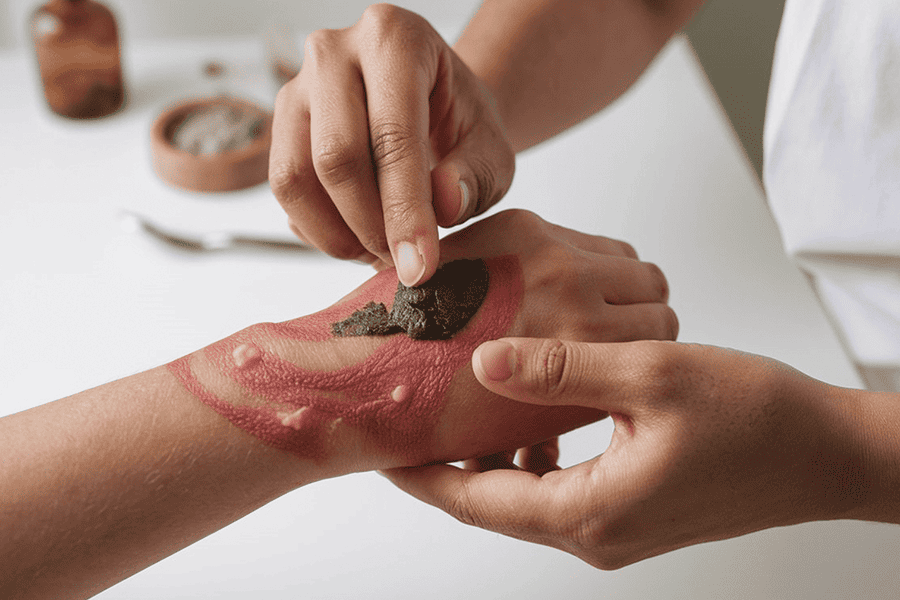
Honey functions as an ideal wound dressing due to its combined physical and biological properties:
Moist healing environment:
It maintains optimal moisture balance, which accelerates epithelial migration and prevents desiccation of tissues.
Barrier against infection:
Its viscous nature forms a protective layer over the wound, preventing microbial contamination.
Reduced scar formation:
By modulating inflammation and collagen deposition, honey improves scar quality and reduces fibrosis.
Reduced antibiotic resistance risk:
Unlike conventional antibiotics, honey exerts multifactorial antimicrobial effects, reducing the risk of resistance development.
Clinical applications
Madhu is widely used in:
- Chronic Dushta Vrana (infected ulcers)
- Diabetic foot ulcers
- Venous leg ulcers
- Pressure sores
- Burn wounds
- Post-surgical infected wounds
- Traumatic ulcers
- Sinus tracts and delayed-healing wounds
It is often used alone or in combination with formulations such as Jatyadi Taila or herbal pastes.
Advantages in chronic ulcer care
- Natural and cost-effective dressing
- Broad-spectrum antimicrobial action
- Promotes autolytic debridement
- Enhances tissue regeneration
- Reduces inflammation and pain
- Suitable for long-term use
Conclusion
Madhu (honey) is a scientifically validated natural bioactive dressing with significant relevance in the management of Dushta Vrana. Its classical Ayurvedic properties as a wound purifier and healer are strongly supported by modern evidence demonstrating antimicrobial, anti-inflammatory, antioxidant, and regenerative actions. By maintaining a moist wound environment and actively promoting tissue repair, honey serves as an effective, safe, and multifunctional agent in chronic ulcer management.
Reference:
- Fazalda A, Quraisiah A, Nur Azlina MF. Antiulcer Effect of Honey in Nonsteroidal Anti-Inflammatory Drugs Induced Gastric Ulcer Model in Rats: A Systematic Review. Evid Based Complement Alternat Med. 2018;2018:7515692. Published 2018 Jul 15. doi:10.1155/2018/7515692 https://pmc.ncbi.nlm.nih.gov/articles/PMC6076929/
- Molan PC. The evidence supporting the use of honey as a wound dressing. Int J Low Extrem Wounds. 2006 Mar;5(1):40-54. doi: 10.1177/1534734605286014. Erratum in: Int J Low Extrem Wounds. 2006 Jun;5(2):122. PMID: 16543212. https://pubmed.ncbi.nlm.nih.gov/16543212/