
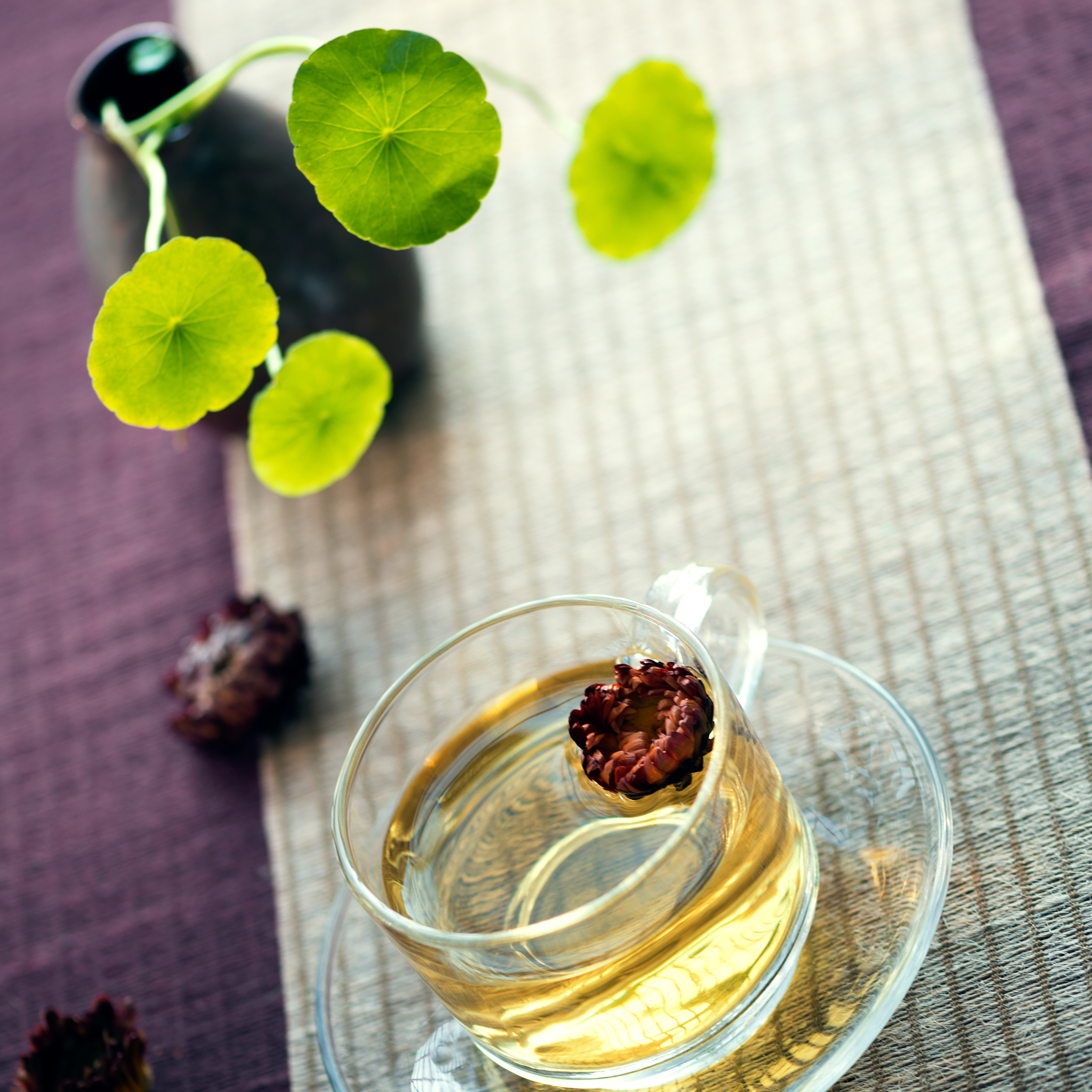
Gotu kola (Centella asiatica), commonly known as Indian pennywort or Asian pennywort, is a medicinal herb belonging to the Apiaceae family. It has a long history of use in Ayurveda and traditional Chinese medicine, particularly for supporting skin health, wound healing, cognitive function, and circulation. Modern pharmacological research has investigated its bioactive compounds and their potential antioxidant, anti-inflammatory, neuroprotective, and tissue-repairing effects. However, traditional use and promising laboratory findings do not necessarily establish clinical effectiveness, and further high-quality human studies are needed to clarify its therapeutic role.1
Phytochemical constituents and mechanisms of action
The therapeutic potential of Gotu kola is primarily associated with its pentacyclic triterpenes and triterpenoid saponins. Important constituents include asiaticoside, madecassoside, asiatic acid, and madecassic acid. The plant also contains flavonoids, polyphenolic compounds, sterols, and other phytochemicals that may contribute to its biological activity.
These constituents have demonstrated several pharmacological effects in experimental studies:
- Antioxidant activity: Gotu kola contains compounds that may help neutralize reactive oxygen species (ROS) and reduce oxidative stress. By limiting free-radical-mediated cellular damage, these constituents may help protect tissues from oxidative injury and support normal cellular function
- Anti-inflammatory activity: Asiaticoside, madecassoside, and their related triterpenic acids have demonstrated potential to modulate inflammatory pathways. They may influence the activity of pathways such as nuclear factor kappa B (NF-κB) and reduce the production of certain pro-inflammatory mediators. These effects may contribute to the regulation of inflammation and tissue recovery
- Collagen synthesis and tissue repair: Gotu kola has been investigated for its effects on fibroblast proliferation, collagen synthesis, and extracellular matrix formation. Asiaticoside and asiatic acid may support collagen production and tissue remodeling, providing a possible explanation for the plant's traditional use in wound healing and skin repair. These properties have also generated interest in its potential role in scar management and dermatological applications
- Neuroprotective activity: Certain triterpenoids and other phytochemicals in Gotu kola may influence pathways associated with neuronal oxidative stress, inflammation, and cellular survival. Preclinical studies suggest possible effects on neuronal function, synaptic activity, and cognitive processes. However, the extent to which these effects translate into clinically meaningful benefits in humans remains uncertain.
- Microcirculatory and vascular effects: Gotu kola has also been investigated for its potential effects on connective tissue and venous microcirculation. Some preparations containing Centella asiatica triterpenes have been studied in chronic venous insufficiency, where improvements in selected microcirculatory parameters have been reported
These mechanisms provide a scientific basis for further investigation of Gotu kola in dermatology, neurology, and other clinical fields.2
Therapeutic and pharmacological applications
Wound healing and dermatological applications:
One of the most extensively studied applications of Gotu kola is wound healing. Its triterpenoids may promote collagen synthesis, fibroblast proliferation, angiogenesis, and re-epithelialisation, which are important processes in tissue repair. Topical formulations, including creams, gels, and advanced delivery systems, have been investigated for burns, minor wounds, scars, and chronic ulcers.3
Cognitive function and neuroprotection:
Gotu kola has traditionally been used to support memory, concentration, and mental alertness. Its constituents may protect neuronal cells by reducing oxidative stress and modulating inflammatory pathways. Researchers have also investigated its potential in age-related cognitive decline and neurodegenerative disorders.4
Anti-inflammatory and antioxidant effects:
Bioactive compounds in Gotu kola may influence inflammatory signalling pathways, including nuclear factor kappa B (NF-κB), and support cellular antioxidant defences. These effects have been investigated in experimental models of inflammatory and oxidative tissue injury. Such findings may help explain the plant's traditional applications in skin disorders and tissue repair, but the clinical significance of these mechanisms remains under investigation.
Venous circulation and microvascular health:
Standardised triterpenic extracts of Centella asiatica have been studied for their potential effects on microcirculation, capillary permeability, and venous symptoms. They are use in chronic venous insufficiency and certain microvascular complications.
Formulations and Clinical Use
Gotu kola is available in several forms, including fresh leaves, dried plant material, powders, oral extracts, capsules, and topical preparations. The concentration of active constituents can vary according to the plant source, extraction method, processing conditions, and formulation.
For clinical and research purposes, standardisation of triterpenoid content and quality control are important. There is no single universally established dose for all indications, and dosing should not be extrapolated from one preparation to another. Clinicians should consider the intended indication, available clinical evidence, product quality, and patient-specific safety factors before considering its use.
Conclusion
Gotu kola (Centella asiatica) is an important medicinal plant with a broad range of traditional applications and promising pharmacological properties.5 Its most actively investigated areas include wound healing, dermatological care, neuroprotection, inflammation, and microvascular health. However, the strength of clinical evidence differs across indications, and many proposed benefits remain supported primarily by laboratory and preclinical research. Standardised formulations, rigorous clinical trials, and continued safety monitoring are essential to establish its appropriate role in evidence-based healthcare.
Reference:
- Sun B, Wu L, Wu Y, et al. Therapeutic Potential of Centella asiatica and Its Triterpenes: A Review. Front Pharmacol. 2020;11:568032. Published 2020 Sep 4. doi:10.3389/fphar.2020.568032 https://pmc.ncbi.nlm.nih.gov/articles/PMC7498642/
- Bandopadhyay S, Mandal S, Ghorai M, et al. Therapeutic properties and pharmacological activities of asiaticoside and madecassoside: A review. J Cell Mol Med. 2023;27(5):593-608. doi:10.1111/jcmm.17635 https://pmc.ncbi.nlm.nih.gov/articles/PMC9983323/
- Witkowska K, Paczkowska-Walendowska M, Garbiec E, Cielecka-Piontek J. Topical Application of Centella asiatica in Wound Healing: Recent Insights into Mechanisms and Clinical Efficacy. Pharmaceutics. 2024;16(10):1252. Published 2024 Sep 26. doi:10.3390/pharmaceutics16101252 https://pmc.ncbi.nlm.nih.gov/articles/PMC11510310/
- Puttarak P, Dilokthornsakul P, Saokaew S, et al. Effects of Centella asiatica (L.) Urb. on cognitive function and mood related outcomes: A Systematic Review and Meta-analysis. Sci Rep. 2017;7(1):10646. Published 2017 Sep 6. doi:10.1038/s41598-017-09823-9 https://pmc.ncbi.nlm.nih.gov/articles/PMC5587720/
- Yuwadee A, Boonprasert K, Na-Bangchang K. Pharmacological Activities of Centella asiatica: A Systematic Review of Preclinical and Clinical Evidence on Cardiovascular, Neurological, Antioxidant, and Anti-inflammatory Effects. Planta Med. Published online October 21, 2026. doi:10.1055/a-2969-6239 https://pubmed.ncbi.nlm.nih.gov/42906579/