
Introduction
Skin diseases constitute a significant healthcare burden due to their chronicity, recurrent nature, and impact on quality of life. Ayurveda considers the skin (Twak) to be closely associated with Rakta Dhatu, and disturbances in blood quality are regarded as a major etiological factor in many dermatological conditions. The vitiation of Rakta by aggravated Pitta Dosha leads to manifestations such as erythema, burning sensation, itching, pigmentation, suppuration, and inflammatory lesions.
Among the purification therapies described by Sushruta, Raktamokshana occupies a unique position because it directly targets vitiated blood. Classical texts consider it particularly effective in disorders where conventional internal medications alone may provide incomplete relief.1
Ayurvedic basis of raktamokshana
Ayurveda describes Raktamokshana as a procedure for removing impure blood and alleviating diseases arising from Raktadushti. The therapy is believed to:
- Eliminate accumulated toxins and inflammatory factors
- Reduce Pitta and Rakta vitiation
- Improve local circulation
- Relieve itching, burning, and pain
- Promote healthy skin regeneration
Different techniques are selected according to the location, severity, and nature of the disease.
Types of raktamokshana
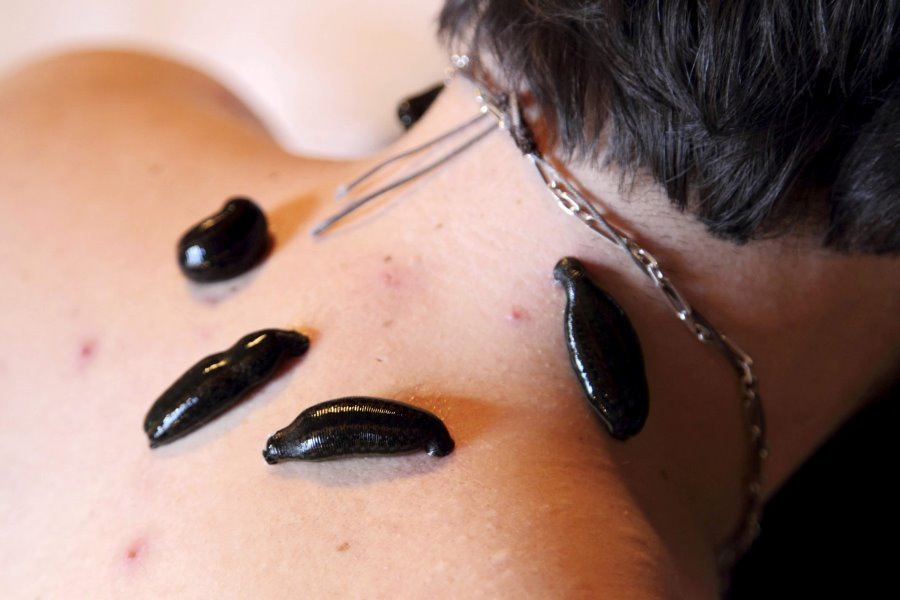
Jalaukavacharana (Leech Therapy):
Leech therapy is considered the safest and most commonly employed method in dermatological practice. Medicinal leeches remove small quantities of blood while simultaneously introducing bioactive substances possessing anticoagulant, anti-inflammatory, analgesic, and microcirculatory effects. It is particularly useful in inflammatory and sensitive skin conditions.2
Siravyadha (Venesection):
Siravyadha involves controlled puncture of a vein for removal of vitiated blood. It is generally indicated in systemic conditions associated with extensive blood vitiation and chronic inflammatory disorders.
Prachchhana (Scarification):
This method involves superficial skin incisions followed by bloodletting. It is useful in localized dermatological lesions with discoloration, itching, and chronic inflammation.
Alabu and shringa therapy:
These methods employ negative pressure techniques to remove impure blood from affected regions and are occasionally utilized in localized skin disorders.
Clinical applications in dermatology
Raktamokshana is traditionally employed in:
- Psoriasis (Kitibha Kushtha)
- Eczema (Vicharchika)
- Acne vulgaris (Yuvanapidika)
- Urticaria (Sheetapitta)
- Vitiligo (Shwitra)
- Chronic dermatitis
- Varicose ulcers
- Non-healing wounds
- Localized inflammatory skin disorders
Clinical studies have reported reductions in erythema, itching, scaling, inflammation, and lesion severity following bloodletting procedures, particularly when combined with appropriate Ayurvedic medications.
Possible modern mechanisms
Recent research suggests several mechanisms that may contribute to the therapeutic effects of Raktamokshana:
- Reduction of local inflammatory mediators
- Improvement of microcirculation and tissue oxygenation
- Modulation of immune responses
- Removal of inflammatory metabolites
- Enhancement of wound-healing processes
- Reduction of vascular congestion
In leech therapy, biologically active compounds such as hirudin, calin, and destabilase further contribute to anti-inflammatory and tissue-protective effects.
Conclusion
Raktamokshana represents a distinctive Ayurvedic para-surgical procedure for managing dermatological disorders associated with Raktadushti. By eliminating vitiated blood, reducing inflammation, improving circulation, and supporting tissue healing, it addresses key pathogenic factors underlying chronic skin diseases. Contemporary scientific evidence increasingly supports its anti-inflammatory and microcirculatory benefits, particularly in the context of leech therapy. When integrated with herbal medications and dietary management, Raktamokshana offers a comprehensive and individualized approach to dermatological care.
Reference:
- Whitaker IS, Rao J, Izadi D, Butler PE. Historical Article: Hirudo medicinalis: ancient origins of, and trends in the use of medicinal leeches throughout history. Br J Oral Maxillofac Surg. 2004 Apr;42(2):133-7. doi: 10.1016/S0266-4356(03)00242-0. PMID: 15013545. https://pubmed.ncbi.nlm.nih.gov/15013545/
- Sig AK, Guney M, Uskudar Guclu A, Ozmen E. Medicinal leech therapy-an overall perspective. Integr Med Res. 2017;6(4):337-343. doi:10.1016/j.imr.2017.08.001 https://pmc.ncbi.nlm.nih.gov/articles/PMC5741396/